

In my last post, I argued that, if AI accelerates growth in rich countries, it becomes crucial to accelerate catch-up growth in poor countries. If we manage to do it, we create a lot of welfare. If we don’t, hundreds of millions will lag behind. This matters not only because people would miss out on consumption goods, but because they would suffer from hunger and deprivation and die earlier than necessary.1 So I think accelerating catch-up growth after transformative AI (TAI) really matters!
The multi-trillion-dollar question is: how?
I think the answer is this: do everything you can to accumulate productive AI-enhanced capital. In the TAI world, frontier growth is driven by robots doing activities of economic value. Whoever owns the robots gets rich, so poor countries should try to own more robots. Throughout, I take TAI as given and ask what follows. I’m not predicting that it will happen, or when.
This sounds obvious, but it’s often overlooked. I've seen smart people saying that countries should create a sovereign wealth fund to buy stocks in frontier AI companies, or resist the urge to do anything and let markets operate, or bet on sending their workers abroad so they will send remittances back.2
So how can poor countries accumulate the AI-enhanced machines that drive growth? At a high level, the problem looks close to hopeless. Exporting gets harder, capital flows uphill, and poor countries get a relatively small growth boost from the first wave of cognitive AI. The export-led labor-intensive growth model that has reigned since the Second World War probably stops working.
To get unstuck, we go down to the firm level. The core of this post is therefore a deep dive into the drivers of firms’ technology investment decisions. The exercise provides a map for countries to trace their own growth paths after TAI. The key task is to diagnose where firms get stuck and use policy to unblock them. Then countries can get into a positive feedback loop, where investment drives technological upgrading, which raises incomes, which funds more investment.
The map doesn’t give one answer, but the answers rhyme. Run it on almost any poor country after TAI and the same workarounds keep showing up. I think they add up to a new growth model, the AI-intensive bootstrapping growth model.
I am, of course, uncertain about this and would love to get a debate going. I hope this will help start an economic policy and philanthropic grantmaking agenda to help accelerate catch-up growth post TAI.
How rich countries grow after TAI
To answer how poor countries can grow in the aftermath of TAI, let's recall how rich countries grow. As AI capabilities grow, machines become more capable of performing economic activities, so more tasks are allocated to machines, and the growth rate increases.3
Higher automation leads to higher growth because, as the economy approaches full automation, its growth rate gets closer and closer to the growth rate of capital. Producing anything takes a bundle of tasks. Today, people do most of those tasks and machines do some. If you add machines but not workers, you run into the tasks only people can do. A factory with twice the robots and the same staff doesn't make twice as much. Economists call this diminishing returns to capital, and it's why capital accumulation has never been enough to make growth explode.
Under TAI, automation erodes that bottleneck. The more tasks machines can do, the less each new machine is held back by the scarce human ones. At the limit, as Moll and Imas put it in a great recent post, "machines produce output and output is used to build more machines, so the economy keeps growing without labor being a bottleneck." In economists' terms, the economy becomes an "AK" model, and the growth rate can become very high.4
Moll and Imas then argue this won't happen soon, because diffusion is slow, most work is physical, and spending shifts toward whatever stays scarce. Their bottom line is that double-digit growth in the next 10 to 15 years is "extremely unlikely," and that "a much more reasonable baseline is, say, 4-5%" a year. I am more AGI-pilled than that, but even this smaller number leaves catch-up enormously important.5
How poor countries get stuck
What I will paint here is close to the worst-case scenario. Things might turn out to be easier than this, and in later sections I discuss how prescriptions change if we relax the scenario. But if we want to create a robust solution to the challenge of post-TAI growth, we should start from the hard case.
I expect frontier takeoff to create two big problems for poor countries.
First, it gets much harder to export. Historically, poor countries used cheap labor to become more competitive in exports, but automation erodes that advantage. Rich countries, with factory lines staffed by robots, are likely to outcompete poor ones in most labor-intensive goods. The export-led labor-intensive manufacturing model probably stops working for most countries.6 That matters because exports do three jobs at once. They earn the dollars to buy foreign equipment, they put local firms in contact with demanding buyers who push them to upgrade, and they give firms a market much bigger than the one at home.7
Second, capital flows uphill. The high growth rate under AI-induced takeoff creates great investment opportunities in frontier economies.8 That means frontier economies can productively absorb a lot of capital, which reduces the capital available to poor countries.9 I’d expect interest rates in the rich world to rise. That means less foreign direct investment, and so less of the know-how foreign firms bring, and higher interest rates on whatever poor countries borrow.
To make things worse, poor countries get little out of the first phase of takeoff, which automates cognitive work. The US has a high fraction of GDP in cognitive sectors such as finance, biotech research, consulting, law, and media, so it can easily get more productive with cognitive AI.
Most people in the Democratic Republic of the Congo work in agriculture. It lacks roads, airports, food, drugs, trucks, houses, and a myriad of physical goods, so it doesn’t get much of a boost from cognitive AI. A DRC with huge AI-powered consulting and law sectors is still a country with great material deprivation.10
Put together, this is a poverty trap. Poor countries don’t gain much from cognitive AI, borrowing costs increase, and dollars become scarcer. Since growth after TAI is mostly about investment, too little investment means lagging technology, too little production, and too little money to invest the next year.
They still benefit from AI. They get cheap or free LLMs on their phones, better entertainment, better drugs, and education. The very rich within these countries get richer by investing in frontier tech abroad. But productive machines play little role in the internal economy, and most people have low-tech, poorly paid jobs.

AI’s vision of São Paulo stuck in a low-growth trap (ChatGPT).
How poor countries can get unstuck
The key task is to find a way, any way, to invest in productive technology. But what kind of productive tech? I will call it all “machines” for short (and occasionally use “robots” and “capital” to mean the same thing). What first comes to mind is a humanoid robot working in a factory, but what I mean is much broader, and can be much less advanced. “Machine” can be a drone using AI to autonomously spray agricultural fields or a self-driving truck. It can even be an AI software system. The key ingredients for “machine” are that it is used to produce things of economic value, costs money to obtain, and is complementary to cognitive AI.
Why are machines so central? Robert Solow argued that in the long run growth is driven by knowledge, not capital. I very much agree with Solow, but I think that after TAI knowledge moves out of people’s heads and into thinking machines. So the difference between capital accumulation and productivity growth via knowledge gets muted. Whoever has the best machines also has the best productive knowledge.
With the productive knowledge available in frontier economies embedded within machines, catch-up growth primarily means getting these machines.
But just buying a ton of machines is too crude a goal. Blind capital accumulation can lead to incredible waste, as the experience of the USSR shows. Soviet planners poured capital into plants that made a lot of things few people wanted.
To avoid that, productive AI capital accumulation needs to be driven by firms operating in competitive markets and seeking to make profits. Market discipline avoids waste, because a machine that makes a profit, by definition, produces more than it costs to buy and run.
Therefore, to create a plan for poor countries to catch up after TAI, let’s zoom into a firm’s decision whether to adopt a new productive technology. Going down to this level, we will hopefully find ways of bypassing the more abstract problems of exporting, interest rates, and FDI.
The central question: should I buy the machine?
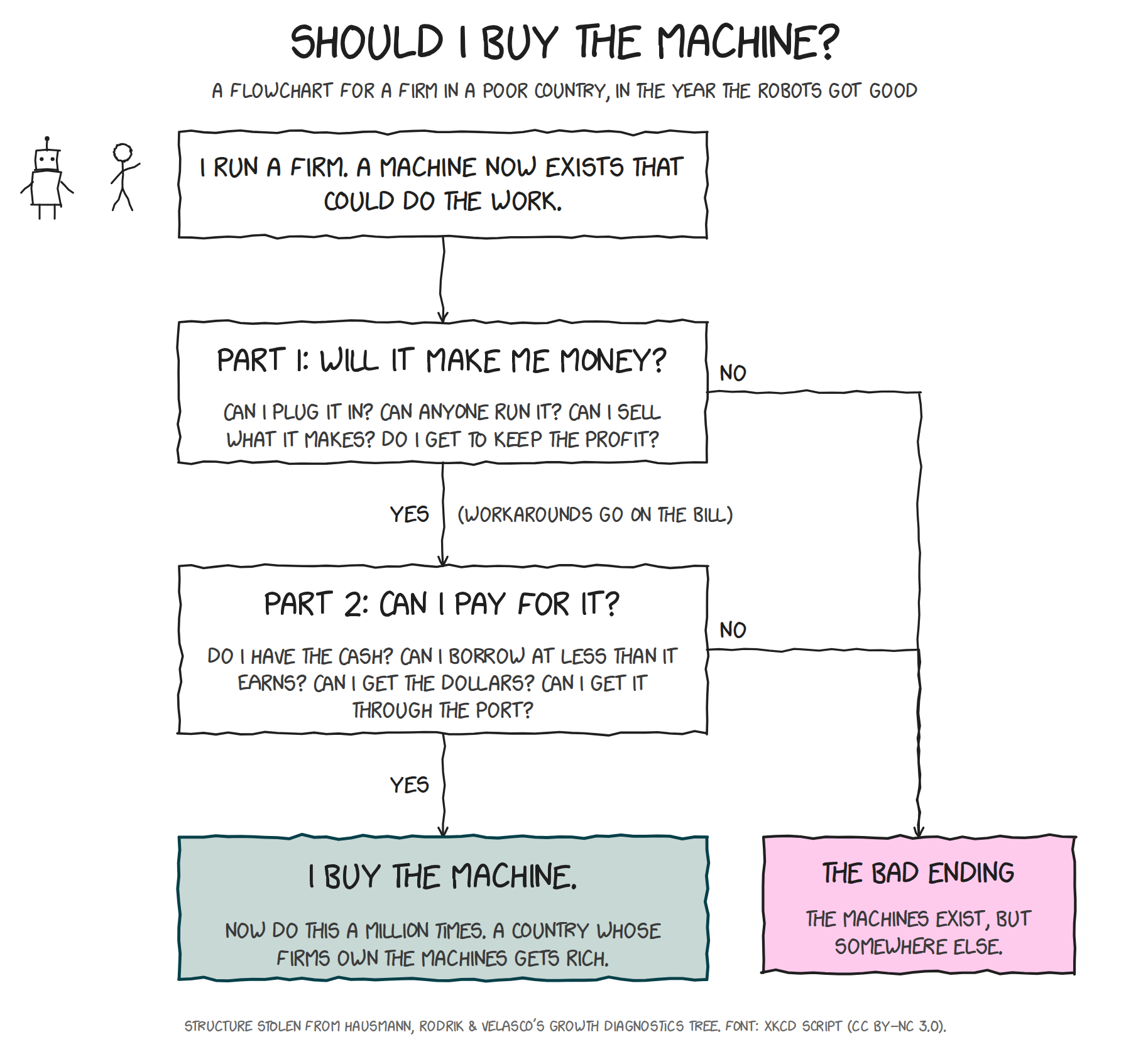
Should I buy the machine? The style is borrowed from xkcd, the great master of the genre.11
The decision has two parts.12 Part 1 asks whether the machine will make enough money, and Part 2 asks whether the firm can pay for it.
The solution to growth after TAI is not the flowchart. The flowchart is a map that each country should use to trace its own solution. Since different countries will face different constraints, we need to identify what exactly is preventing investment before tracing a plan.13
The way to use the map is to apply it to a specific set of firms. It can be a whole country, a sub-national region, or a sector. Go there, interview firms, gather data, compare with similar firms in other places and see if you can detect what is preventing investment.
Good diagnosis is crucial because a single “no” pushes the whole investment decision to a “no”. That makes the flowchart look a lot like the O-ring production function, from a famous paper by Nobel laureate Michael Kremer. Inputs to firms are highly complementary, and investing in the wrong one can be worthless for growth. If Brazilian firms don’t invest because interest rates are too high, then building up energy or connectivity infrastructure becomes virtually useless.
Will a self-driving tractor make me enough money?
Let’s go through how each box in the flowchart matters, how TAI changes it, and what firms and countries stuck there can do.
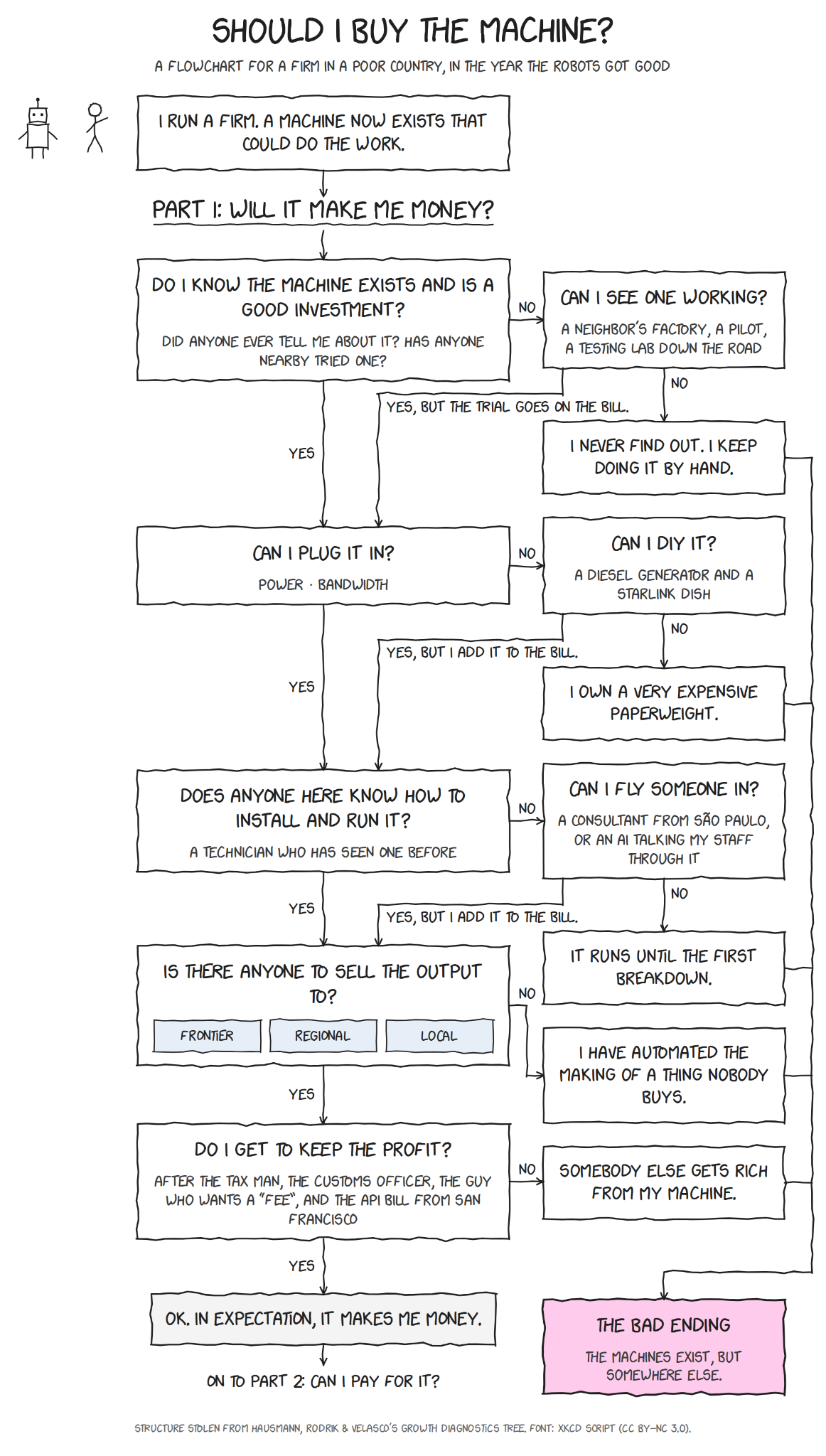
Part 1 of the flowchart. Will the machine make me money?
1. Do I know the machine exists and is a good investment?
The first box is about information. A manager has to know the machine exists and believe it will pay off before any of the other questions become relevant.
Because firms can't know a technology's returns before trying it, they tend to experiment too little even when average returns are high (see evidence in this VoxDev review on technology and development).14 A manager in Kampala has far fewer ways to find out what works than one in Phoenix. Experimenting costs money, and a failed bet can sink a firm in Uganda more easily than in the US, where it is much easier to borrow to bounce back.
The problem of experimenting gets harder after TAI, because the menu of machines will change faster. But it also gets easier, because AI itself can help predict investment returns, suggest new tech, and generally improve firm management.
Information interventions can be cost-effective, so if firms are getting stuck here, I expect governments and philanthropies to be able to help.15
One type of intervention I find exciting is sector-specific AI testing labs. Each lab would run a few concrete AI and automation investments in real firms in one sector, say Kenyan horticulture or Bangladeshi garments, and publish the cost, the payback period, and what had to change on the shop floor. The lab would basically be a producer of public ROI estimates. This type of information is an underprovided public good. Firms copy each other fast, so whoever pays for the experiment can't keep the returns, and so nobody pays for it.
There's a good precedent. In the early 1980s, Fundación Chile, a public-private agency, bought and ran a commercial salmon farm to show that farming salmon in southern Chile could make money. Once it had, it sold the farm, and private firms copied the model. Today, Chile is the world's second-largest producer of farmed salmon after Norway.16
2. Can I plug it in?
Say the manager knows about the machine and expects it to pay off. The next question is whether it can run here at all. Access to reliable electricity is a big constraint on firm growth in many developing countries. AI-driven automation will most likely require power, and the cheaper it is, the easier it will be for firms to adopt new tech. Connectivity is another major issue. In Africa, fixed broadband costs a median of 15% of average monthly income, more than seven times the UN's 2% affordability target (ITU). Internet speed and latency don't matter much for chatting with an LLM. But a factory running sensors and machines in real time needs a connection that is fast, cheap and doesn't drop, so connectivity can become a big constraint on AI adoption.
Both power and connectivity are regulated because they tend toward natural monopolies, and in developing countries the roadblock is usually a broken market.17 The solution needs to be country-specific, focused on fixing the local market through policy reform in conjunction with an effort to directly bring in more investment.
3. Does anyone here know how to install and run it?
Even if the firm has the inputs to run the machine, someone still needs to install it, integrate it into production processes, and fix it when it breaks. Setting up and learning how to use new technology to improve productivity requires tacit knowledge, which is best acquired by working with people who already have it. The interaction with advanced foreign producers that FDI provides has historically been of great help.
When Suzuki set up Maruti in India in 1982, local parts makers produced low-quality output inefficiently. To build a cheap car, Maruti trained its suppliers in Japanese production methods and paired them with Japanese partners. Motherson, then a small wiring maker in New Delhi, grew into a multibillion-dollar global parts company, and another firm cut its defect rate from 2,000 to 5–10 per million parts. Famously, China used joint ventures and all kinds of partnerships with advanced foreign firms to acquire production knowledge.
But how can firms acquire tacit productive knowledge in a TAI world where FDI is much scarcer?
Luckily, AI itself can help. Consider a grim example from a NYT article. Boko Haram fighters in Nigeria, blocked by a trench around a military base, asked chatbots how to make their motorcycles jump it. Mechanics modified the bikes following the LLM tips, and the riders practiced until the attack worked. AI can make tacit knowledge much easier to transmit.
This might become even more true in the future. Tacit knowledge is tacit because people don't even know or remember everything they did. But if we have smart glasses, gloves, cameras and speakers to monitor production processes, AI might be able to make explicit knowledge that used to be tacit – and thus make it more transferable.18
In the beginning, firms in poor countries can pair skilled cognitive labor from AI with the cheap human labor they have to do new stuff, like better processing oil into plastics.
In the limit, if production is done by robots, then tacit knowledge becomes downloadable. Before, Brazil needed German engineers to help local firms understand how to produce good car engine parts. If engines in Germany are made by robots, Brazil can just download the German robot engineer software to its robots.19
4. Is there anyone to sell the output to?
Now suppose the machine is up and running. For a productive investment to pay off, the firm needs to sell the product to someone. Local markets are small in poor countries, and exporting will become harder if TAI causes frontier growth to take off. This is a Big Issue, since exporting has been so fundamental for growth in recent decades. Countries can bypass it by trying to squeeze as much revenue as they can from frontier, regional, and local markets.
4a. Frontier: export what you can
A silver lining of the frontier taking off fast and detaching from developing countries is that people in frontier economies would be very rich, and that would lead them to demand more and different goods and services.20 Hopefully, some of those will not be easily produced at the frontier, even with super-advanced robots.
Tourism is a key example. So are other services people will want to buy in person, like medical tourism. (Come to my beloved Brazil to get plastic surgery!)
The extractives sector can also help. Some minerals (like copper) are likely to see higher demand as frontier growth takes off, and countries that have deposits could see a windfall.
The AI build-out itself is likely to create more demand for physical goods, like transformers, cables, cooling equipment and power generation. Countries that already make things close to these can try to join that supply chain.
I'm especially excited about agriculture, since it's a large sector in developing countries and it can plausibly see a lot of new demand. As people in rich countries get richer due to AI, they will probably demand fancier food. Since land and climate are hard to automate, developing countries will remain uniquely able to produce some of these agricultural products. We already see Africa exporting more and more fancy fruits.
4b. Regional: sell more to other developing countries
If frontier economies are taking off and not demanding enough from developing countries, developing countries can sell more to each other.
That's why I think regional integration is a good way to accelerate growth post TAI. That's what the AfCFTA and other regional trade deals, like the East African Community (EAC), ECOWAS in West Africa and Mercosur in South America, are trying to build. Most of these projects are moving slowly, and TAI is a good reason to speed them up.
4c. Local: sell more at home
Domestic markets are an underrated part of historical growth. In the late 19th century, before the export-led growth model appeared, the US grew very fast with exports always below 10% of GDP. Even export champions like South Korea relied on domestic demand at some point. Hyundai's Pony (1975), Korea's first mass-produced car, was nicknamed 'kukmincha' or 'car for the people' and dominated the domestic market before Hyundai started exporting. Home markets are also easier places for young firms to learn. Local buyers accept lower quality, logistics are simpler, local entrepreneurs know their customers, and proximity to customers enables quicker iteration on product design and quality.
TAI adds another reason. The difficulty of competing in international markets itself makes it easier to sell at home. If a country exports little, there is little foreign currency around. The local currency depreciates and it gets easier for domestic producers to be cheaper than imports.
A key concern here is whether the domestic market can provide enough demand for the industrialized goods that AI helps produce. My counter is twofold. First, AI can help produce all goods, even the basic goods like food, housing and transportation that poor consumers first demand.
Second, AI-fueled growth can help increase demand, in a bootstrapping loop where supply and demand help each other. This will get much easier with a good system of redistribution. If gains from the adoption of AI are concentrated in firm owners, there will be little internal demand (since the propensity to consume is lower among the rich). So sharing the gains from AI-driven production can help increase the local market and fuel further investment in AI-driven production.
I am not saying that countries should now turn inwards, or start protecting domestic industry via high tariffs, as in the Import Substitution Industrialization model. I am just saying that in the search for growth after TAI, domestic markets can play an important role.21 Since firms need scale to sell, this will be particularly true in large countries. Luckily, most poor people live in large countries, such as India, Nigeria, the DRC and Ethiopia.
Infrastructure
Whichever market the firm sells to, it has to get the product there, so transportation infrastructure matters too. Roads, ports, airports, and freight trains connect firms to suppliers and buyers and make it easier to upgrade technologically. AI will help with self-driving trucks and better delivery drones, but the bulk of the solution will still be fixing markets and putting in money to attract large-scale investment.
5. Do I get to keep the profit?
Say the self-driving tractor pays off and the farm makes more money. The firm still has to keep that money. Profits can be taxed heavily, eaten by compliance costs, extorted by officials, trapped by currency rules, or seized outright. Investors price all of this in before they buy the machine.
Corporate taxation and its minutiae, such as capital depreciation rules, become especially important after TAI because they directly affect the payoff from buying the machine. Since the whole game here is increasing investment, regulatory or expropriation risk also becomes more important to avoid.
Can I afford a self-driving tractor?
Suppose the answer to Part 1 is yes, and the machine will make money. The firm still has to pay for it, which Part 2 breaks into five questions:
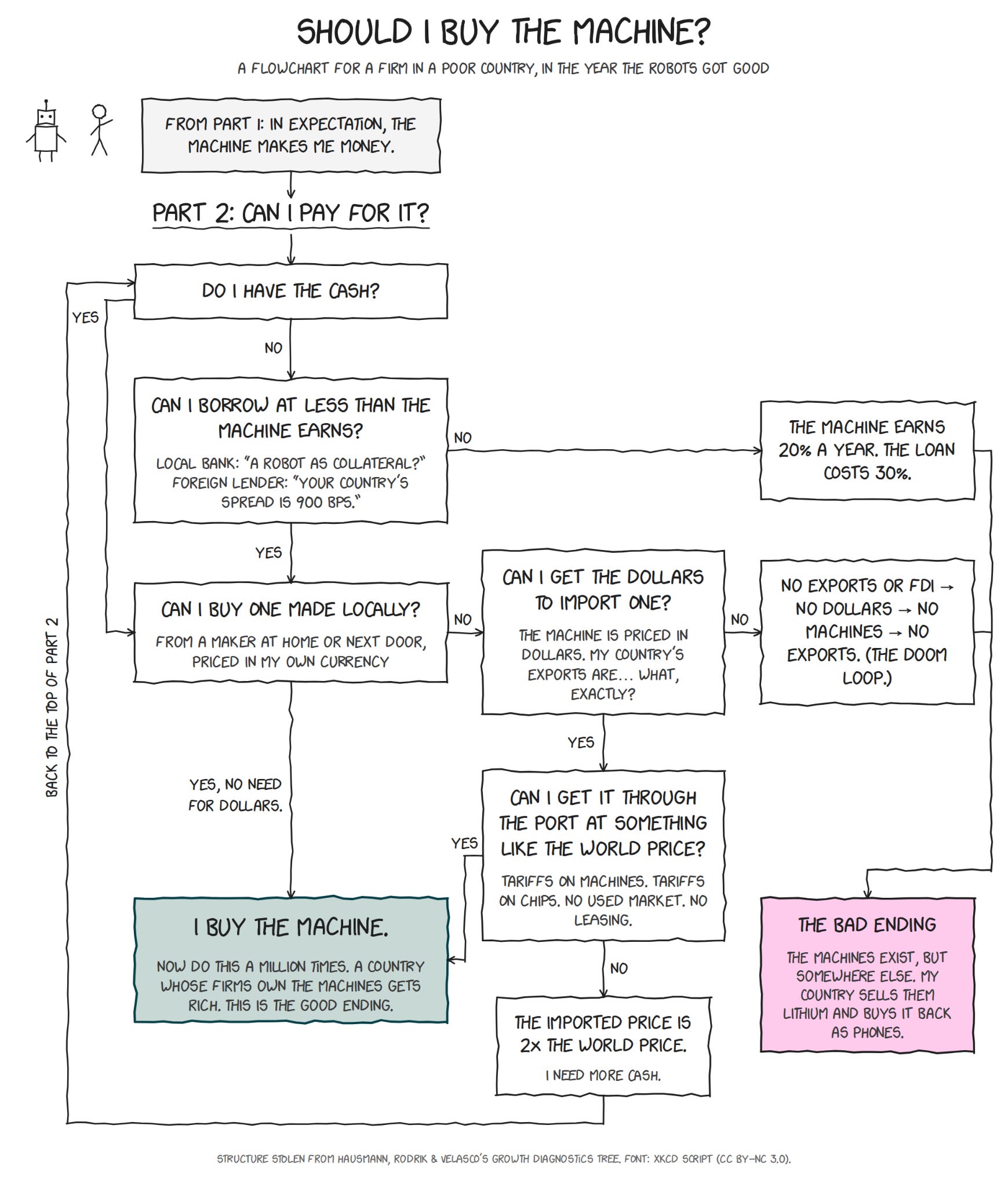
Part 2 of the flowchart. Can I pay for it?
1. Do I have the cash?
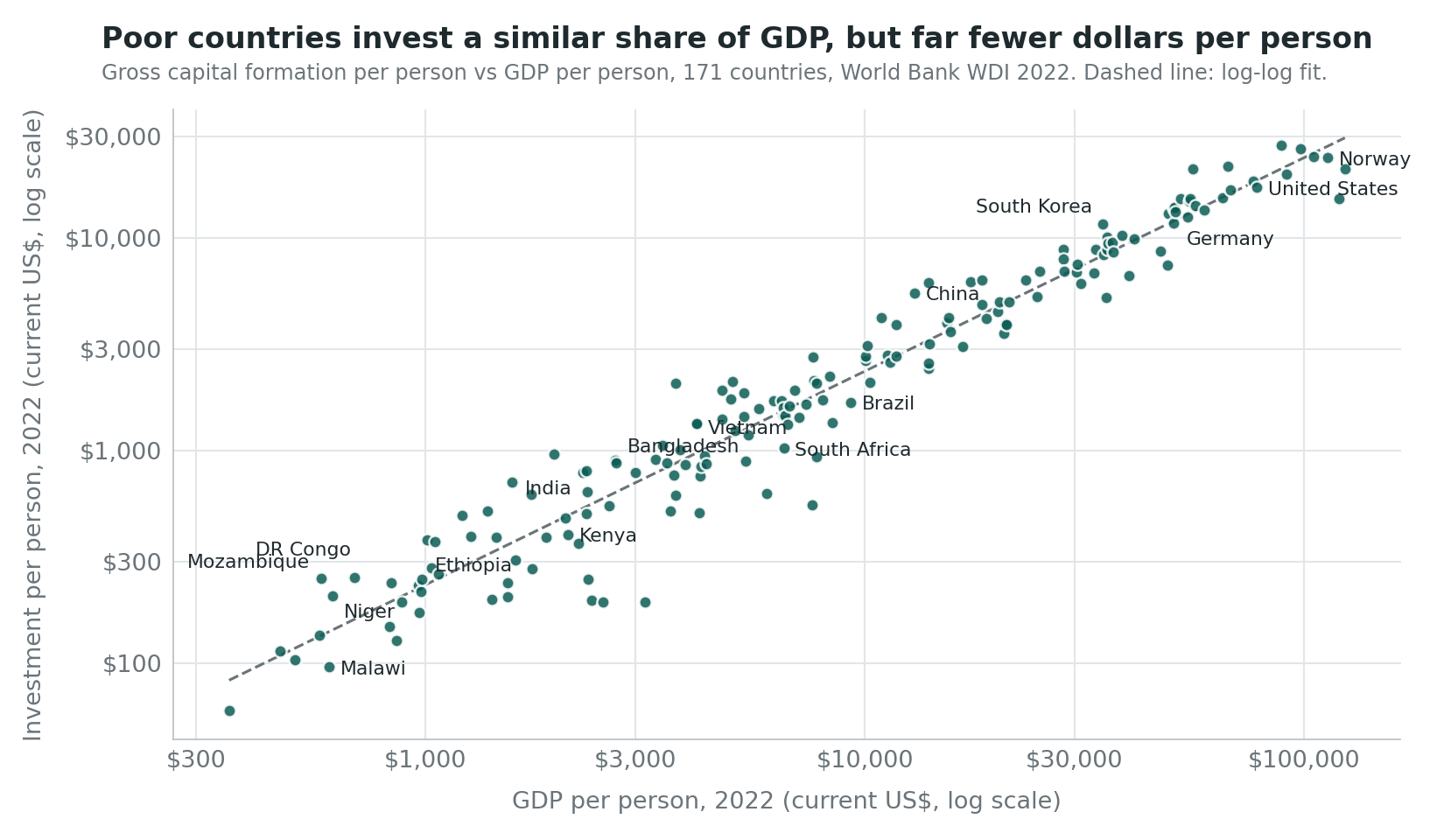
The simplest way to pay is with cash the firm already has, from savings. But poor countries have little savings per person. Poor and rich countries invest about the same share of GDP, around a quarter. But a quarter of very little is very little, about $233 per person a year against $15,239 in rich countries. So most firms won't pay for AI tech upfront.22
2. Can I borrow at less than the machine earns?
A firm without the cash has to borrow, and that only makes sense if the machine earns more than the loan costs. But the cost of capital tends to be higher in developing countries than in rich ones, and the frontier takeoff after TAI causes capital to flow uphill, making the cost of capital even higher.
The good news about capital cost is that it’s a central and well-studied growth problem, so there is a ton of historical experience to draw from. The East Asian economies are the best recent example. China ran the most ambitious version, capping deposit rates well below market so that household savings became cheap loans for state firms.23
I doubt AI provides a shortcut here. It can improve financial intermediation by helping lenders spot good investments and good borrowers, but it cannot increase the pool of savings available to invest.
Most ways of getting more money to invest involve someone getting less money to consume. In most developing countries today, a major driver of high interest rates is too much government borrowing, which comes from too much government spending. Cutting government spending is a highly political issue.24
A hope I have here is for more self-reliance in capital markets. African pension funds hold about $455 billion, but in some countries 70–80% of institutional portfolios sit in government debt. Recently, there have been increasing efforts to unlock this capital to invest in the local economy.
3. Can I buy one made locally?
Once it has the money, the firm has to find the machine. If a country can use AI and robots to build at least some of its own productive machines, it should. A domestic machine industry reduces dependency on foreign technology imports, which alleviates the hard problem of obtaining dollars. Domestic machine producers can also start producing machines that automate their own production of machines, which is the holy grail of AI-intensive bootstrapping.
Developing countries don't have to start with complex robots. Assembly, maintenance, spare parts and refurbishing second-hand equipment are early rungs on the same ladder.
This has historical precedents – the late 19th-century US is again a good example. A domestic machine-tool industry grew out of the armories and gun makers of the early nineteenth century and carried its techniques into sewing machines, bicycles and eventually cars (Rosenberg 1963), so American firms mostly didn't need foreign currency to upgrade technologically. After World War II, Japan imported more machine tools than it exported until 1972, and by 1982 it was the world's largest producer of numerically controlled machine tools, ahead of the United States (JMTBA).25
4. Can I get the dollars?
Since the frontier takes off first, at least initially the productive AI tech is made abroad and the firm needs foreign currency to pay for it. Exports and FDI are the main sources, and we discussed those already.
But poor countries should exploit all sources of foreign currency they can get. Labor migration and international aid could be important for some countries.
I would not bet much on migration, since TAI is expected to reduce labor demand in frontier economies. People in the US are very concerned about a future lack of jobs, so presumably there won’t be much demand for migrant labor either. But I could be surprised. For example, if Imas’ thesis that relational jobs remain plentiful holds true, demand for labor in general will continue to be high and some of those jobs could be taken by people from poor countries.
Newly minted AI billionaires are expected to donate a lot. Maybe frontier governments would also donate a lot. With high GDP growth, aid would go up in absolute terms even if aid/GDP remains constant. Call me foolish, but I have some hope that rich societies, spurred by newfound AI-induced extra prosperity, would become more generous and reverse the recent trend of falling aid/GDP.
5. Can I get it through the port?
Even a firm with the cash, the credit and the dollars still has to get the machine through the port at a reasonable price. Many poor countries put tariffs on capital goods and electronics, and their customs are slow and unpredictable. Each of these pushes the local price of a machine above the world price, so the same dollar buys fewer machines.
The effect is big. Eaton and Kortum (2001) estimate that differences in the price of equipment explain about a quarter of the productivity gaps between countries, and that barriers to trade in equipment explain about half of that.
The good news is that this is one of the easiest constraints to relax. Cutting tariffs on machines, chips and solar panels is a decision a government can mostly make on its own, and it makes every other dollar of investment go further. And since frontier firms replace their machines quickly, second-hand robots and servers could become a cheap source of capital for poor countries, as long as they're allowed in.26
A new model: AI-intensive bootstrapping

AI’s vision of São Paulo after getting into the AI-intensive bootstrapping loop (ChatGPT).
Looked at from above, growth after TAI is a grim problem. The export-led labor-intensive manufacturing model probably stops working, capital flows uphill, and poor countries get little from the first wave of cognitive AI. Thinking at that level, we get stuck.
But going down to the level of the firm changes the picture. The flowchart doesn’t hand every country the same plan. A Brazilian firm may be blocked by interest rates and a Nigerian one by power, so each country has to find its own binding constraint. But when you run the map on poor countries after TAI, the same workarounds keep coming up. A firm that can’t export can sell at home or to its neighbors. One that can’t learn from a foreign partner can learn from AI. One that can’t get dollars can buy a machine made locally, and one that can’t borrow abroad can tap local savings.
Those recurring answers add up to a new growth model, which I call AI-intensive bootstrapping. It’s AI-intensive because it embraces AI use to improve material welfare. Increasing firm investment in AI-enhanced machines is the central task, and AI can also be used to trace the growth path itself. It can help firms decide what machines they should buy, help investors allocate investments across firms, and even help countries diagnose where firms are getting stuck and what policy reforms have the highest bang-for-the-buck in terms of growth.
It’s bootstrapping because each round of growth funds the next. Machines help make more machines. Firms that invest become more productive and pay higher incomes, which create demand for more products and justify more investment. And local savings finance local investment.27 Poor countries export all they can and import all the frontier tech they can, but if global consumers are not buying their products and global investors are not coming, they don’t sit and cry. They help themselves. That’s roughly how the United States, the most economically successful country on earth, caught up with Europe in the late 1800s. It exported little, had a thriving local market, and built its own machine tools.28
The main ways this could be wrong, irrelevant, or fail
It’s pretentious to propose a new growth model (though poor countries need solutions!). It would be even more pretentious if I didn’t consider the many ways I can be wrong.
1) AI kills everyone or creates Bigger Problems
If everyone dies, nobody cares about growth.
But even if that doesn’t happen, we might be too concerned about dying soon to care about growth. The geopolitical implications of TAI are hotly debated, but it’s possible that it would disrupt nation-states, lead to authoritarianism, or make wars and disease more frequent, sucking up the energy that would otherwise go to growth.
2) Jobs and redistributive politics
Up to 12 million young Africans enter the labor market each year, but the region creates only about 3 million formal jobs a year (World Bank). If TAI mainly raises growth by automating production, why would countries that need so many jobs embrace it?
In fact, one of the main alternatives to the export-led manufacturing model in the literature is focused exactly on creating good jobs. Dani Rodrik and Rohan Sandhu propose a new growth model centered on raising productivity in the labor-absorbing services where most urban workers in poor countries already are.
I think it’s a good strategy, and much of it complements mine. One of Rodrik and Sandhu’s four strategies is giving workers and firms technologies that complement low-skilled labor. I agree. The fact that low-skilled labor is relatively cheap in developing countries will make AI applications that complement labor more attractive in them than in frontier economies. Firm investment in capital that is complementary to AI can include human capital, and profit-seeking firms should be able to find those. Examples include training workers to build, install or repair machines, and having workers use cognitive AI to do tasks machines can’t do well (see the example in 3a below).
But in the more radical TAI scenario I assume the world eventually gets to, machines become better than humans in most tasks.29 Then focusing on jobs is a transitional strategy rather than a long-run solution. Embracing automation, though, creates a hard income distribution problem.
Rodrik and Sandhu value good jobs for growth and because, in their words, they are “the only sustainable way” to lift people at the bottom. Under TAI, I think that may stop being true. What ultimately matters is poor people’s consumption, and jobs are one way to deliver it. If machines become more productive than workers at most tasks, insisting on jobs means giving up output. I then believe that the best long-run solution is to embrace automation and share the gains via taxes, transfers and distributed capital ownership instead. Sharing the gains also grows the home market that firms sell to, as I argued in the section on local markets.
Designing the right schemes to share the gains from automation will be an important and hard task. There’s a tradeoff between incentives to invest and taxation, and the optimal design will change as technology and demand for labor evolves. The task will be hard not only technically, but primarily politically. In fact, I expect that creating a political coalition for AI-intensive bootstrapping will be the hardest task in implementing the model. The politics of income distribution after TAI is also a hotly debated topic in advanced economies, and a proper discussion deserves a lot of words. This post already has a lot of words, so I will save the discussion for another time.
3) Maybe poor countries should just invest abroad
I said at the start that whoever owns the robots gets rich. So why bother with the flowchart? A poor country could save, put the money in a sovereign fund that buys shares in frontier AI companies, and pay the dividends to its citizens. Capital flows uphill because returns are higher at the frontier, so this might even pay better than building at home.30
This is a key alternative to the AI-intensive bootstrapping model, and I think it will be part of the solution in some cases. Small countries with TAI-related extractive windfalls, for example, should diversify their portfolio and invest part of it abroad. But I still believe that the core long-run strategy for the countries where most poor people live should be trying to adopt AI technology for local (domestic or regional) production, for two reasons:
3a) Investing only abroad wastes the resources poor countries have
TAI causes a technological explosion, but physical constraints don't go away. Land, sunlight and water will stay valuable, and poor countries have a lot of them. Growing crops in a field will stay much cheaper than growing them under lamps.31
Transport costs matter too. Cement, bricks, steel beams, fresh food and electricity are heavy, bulky, perishable or hard to ship, so they tend to be made near the people who use them. Much of what poor people lack, like houses, roads, power lines and clinics, can't be efficiently shipped. In the same way that oil windfalls tend to cause local inflation, a DRC that collects large dividends from the US but builds little at home will mostly see that money bid up the price of the few houses and roads it has.
Even cognitive AI follows some physical constraints. Data centers are more efficiently placed wherever land and power are cheap, and data access restrictions and (possible) latency concerns make local compute important for growth.
Labor is the last resource that would be wasted. In the long run it may matter little, but in the short run poor countries will have hundreds of millions of underused workers. For example, Carl Shulman argues that before robots are built at scale, AI could guide people through skilled physical tasks in real time, through a phone or a headset.32 A worker in Lagos with an AI coach in her glasses can do jobs that used to take years of training, while parking Nigerian money in New York leaves her idle.
Put together, a global planner trying to maximize world output would install a lot of machines in poor countries, because that's where much of the sunlight, land, workers and customers are. When markets don't put machines there, it's usually because of the frictions in my flowchart, and the right response is to remove them.
3b) Living off a foreign portfolio is bad politics
Governments that fund themselves by taxing what their citizens produce have to bargain with those citizens, and over time that bargain builds accountability and state capacity. Governments with an income that doesn't depend on citizens can skip it. Oil is the classic case.33
Also, a large pool of liquid money in a weak state is easy to steal. Since politics is likely the hardest part of growth after TAI (see section 2), a strategy that makes the political-economy part harder makes growth as a whole much harder.
Having productive capacity at home pushes in the opposite direction. Firms that own machines need roads, power, stable money and courts that enforce contracts. They therefore lobby for the public goods my flowchart is about. Their owners and workers pay taxes and have a stake in good policy. Machines spread across thousands of firms are also much harder to loot.
4) Maybe bootstrapping is not necessary
Analyzing 1995-2015 data, Artuc, Bastos and Rijkers find that robot adoption in rich countries has raised their imports from developing countries. The import response is mostly manufactured intermediates such as car parts and electronics components. So rich-country factories that automate get more productive and buy more inputs from developing countries. Hallward-Driemeier and Nayyar find that automation, at least up to a threshold, leads to higher FDI into poor countries.
This contradicts my story that export-led manufacturing gets shut down. Hopefully I’m wrong. The bootstrapping part is a second-best path, a fallback in case the main growth model of past decades stops working.
If countries can export, they don’t get stuck in the “Can I get the dollars?” box, and growth gets easier. The rest of the AI-intensive model still applies.
But I don’t think most countries should count on high export demand and FDI flows. Artuc, Bastos and Rijkers, like most of the (small) development economics literature relevant to AI and growth, extrapolate empirical findings from recent historical trends. But the point of TAI is that it’s a meaningful trend break. Hallward-Driemeier and Nayyar already find that FDI decreases once automation gets high enough. Here I’m primarily concerned with how to grow if the trend break happens and automation gets high enough in frontier economies.
5) Maybe accessing frontier models gets really expensive
Over the last few years AI has gotten cheaper fast. Dwarkesh Patel argues that this could reverse, and compute prices could rise as much as 10x. Firms are already spending real money on AI. The top 1% of US firms in the Ramp AI Index spend about $7,500 per employee each month on AI.
My answer is that this just makes “access to good AI models” another item in the “Can I plug it in?” flowchart box. Like energy and connectivity, good cheap models are necessary for the AI-enhanced capital to pay off. If poor countries are getting stuck in that box, they should make compute and AI models themselves the priority “machine” they need their firms to invest in.34
6) Maybe we don’t have to worry about growth because aid increases a lot
The biggest way things could get fixed without much effort from poor countries is global redistribution. Anton Korinek and Joseph Stiglitz, for example, propose a global redistribution agenda including taxing the rents of frontier firms and reforming global rules on digital taxes, intellectual property and data so that more of the gains from AI go to poor countries.
I support it. I hope AI wealth makes rich societies more generous. But poor countries shouldn't sit and wait for aid to save them, because recent trends point the other way. Official development assistance fell 23% in 2025, to $174 billion, according to preliminary OECD data, and 26 of 34 donor countries cut their budgets.
And building productive capacity is also how poor countries get the most out of whatever redistribution does arrive. A dollar of aid goes further in a country whose firms can turn it into machines, power plants and houses.
Ideas for philanthropic funders
The main question is what developing countries should do to accelerate catch-up, not what external funders should do. Governments and societies are the main characters here; philanthropies are just a sideshow. But my job is to make grants to help accelerate global growth. What does all this mean for grantmakers like me?
I see the agenda having two legs. One is new and specific to AI, and the other is the existing growth agenda, which TAI makes more urgent.
AI-specific work
First, funders can help governments work out what stops their firms from investing in productive AI tech, and then act on the answer. Many governments already have AI plans. Côte d’Ivoire presented its national AI strategy in March 2025. It covers skills, data centers, a sovereign cloud, inclusion and governance, and prioritizes agriculture, health and education. That’s a serious start. But like most national AI strategies I’ve read, it says much more about the supply of compute and the safe use of AI than about why a cocoa processor or a trucking company isn’t buying the machines that would make it more productive. As the flowchart shows, diagnosing and targeting interventions is fundamental. At the Global Growth Fund, we already fund support for governments designing and implementing other growth policies. We’d like to see an ecosystem of government agencies working on post-TAI growth strategies, and of technical assistance providers bidding to help them. We should subsidize that ecosystem so it appears faster than it otherwise would.
Second, philanthropy can directly subsidize firm adoption. Climate finance is a model. Philanthropic funders launched investment funds and helped seed a now-large system channeling private investment into developing-country firms. AI adoption could be similar.
Third, funders can help firms find out how new technology works and if it pays off before they bet on it. Firms underinvest in that information because their competitors might copy and erode the payoff from costly technological experimentation. Testing and demonstration labs like the ones I described above can produce the missing public good. A firm can watch an agricultural drone or a warehouse robot work under local conditions and learn if it’s worth it.
New urgency for existing agendas
TAI creates new challenges, but the solutions pass through the central questions of historical growth, such as lowering the cost of capital, managing sovereign debt, and building the infrastructure that spurs private investment. AI raises the payoff from making improvements in several of these areas.
Exports and foreign exchange. Exporting gets harder, but also more important after TAI. Exports help firms upgrade technologically through contact with frontier firms, and they earn the dollars needed to import machines. Growth Teams embeds advisors in investment and trade agencies to help them pick promising export sectors and give those sectors what they need to grow. In Rwanda, it helped the Rwanda Development Board build an industry exporting business services, which employed about 1,500 people by 2023. J-PAL is starting work with governments to test export promotion, building on evidence like a Tunisian program that generated $58 to $68 in extra exports for every dollar spent.
Cost of capital. High sovereign debt service dries up money for local investment. Government borrowing at home also competes directly with lending to firms. African governments now raise more than half of their financing domestically, and domestic issuance has tripled since 2010, according to the authors of the African Debt Database, who warn that this can crowd out private credit. When local banks can earn 10 to 13% lending to their own government, a firm that wants a loan for a machine has to beat that. In Colombia, foreign investors started buying government bonds that some local banks had been required to absorb. Those banks then raised lending to firms by about 4 percentage points of assets, and the industries that borrowed from them grew faster.
Debt crises can also derail growth directly. After auditors found $7 to 13 billion of hidden borrowing in Senegal, its debt rose to well above 100% of GDP and domestic investment slowed down meaningfully. At the Global Growth Fund, we already work to improve how poor countries raise and manage sovereign debt, as do many other philanthropic funders.
Another way to lower the cost of capital is more lending from multilateral development banks, which is cheaper than commercial borrowing. Donors can also help unlock domestic capital to invest in the local economy, for example by pooling due diligence, taking first losses and training trustees.
Energy. Machines run on electricity, and automation is not viable if electricity is too costly or unreliable. Many developing countries have both problems. In Nigeria, most firms own a generator. In 2023 Nigeria handed electricity regulation to its 36 states, which opens a rare window to get tariffs and rules right from the start, but the country has perhaps 100 trained electricity regulators. We are supporting RMI to help three states set up their regulators, design tariffs that cover costs, and prepare projects investors will fund, in the hope that other states copy what works.
Connectivity and skills. Robots, drones and AI services need cheap, reliable broadband, and firms need technicians who can install, maintain and repair them. Connectivity is a sector like energy, where prices depend heavily on regulation and competition, and philanthropy has helped before. The Alliance for Affordable Internet was launched in 2013 by Tim Berners-Lee’s Web Foundation with the Omidyar Network, Google and the UK and US aid agencies. It pushed governments to adopt spectrum and competition policies that make broadband cheaper. Skills and job training are already a large philanthropic area. The Mastercard Foundation’s Young Africa Works strategy, for example, aims to help 30 million young Africans into work by 2030. These were already worth funding, and AI raises the stakes, especially for reliable business connections and technical skills.
Regional integration. A larger market raises the returns to investing in new technology. Trade deals, cross-border infrastructure and shared data centers are projects where each country captures much less of the return than the region as a whole. Like other public goods, they tend to be underprovided, so philanthropic donors are well placed to help.
Work on growth pre and mid TAI. If AI ends up having a big effect on frontier growth, the field of catch-up growth in general would automatically become the field of catch-up growth post TAI. The key policy levers, grantees, and policymakers that can make a difference to growth are the same, so a great way to prepare is to work on growth before and during TAI.
Parting words
The scenario is uncertain and changing fast, but the costs of inaction are high. My call to developing countries is to focus on helping firms upgrade technologically. My call to donors is to move fast to support them. Back countries that want to find out where their firms get stuck, fund experiments that show what works, and drop what doesn’t. Provide the public goods that accelerate productive investment. Back also the firms doing the catching up. We will get things wrong, so keep an open mind and learn from the evidence generated by actions.
TAI might lead to incredible material prosperity in some countries while others get stuck in a poverty trap for much longer than necessary. Helping countries get unstuck can help hundreds of millions of people escape deprivation, live longer lives, and share in the great material welfare TAI can bring.
Thanks to my Global Growth Fund teammates Oliver Kim and Justin Sandefur for thoughtful comments that much improved the arguments. All errors remain my own.
GDP per capita is highly correlated with how long people live (Our World in Data has the classic chart) and how many live in extreme poverty, and the link is at least partly causal. Pritchett and Summers estimate that the poor economic performance of the 1980s can be blamed for over half a million extra child deaths in developing countries in 1990 alone. Pritchett later showed that a few measures of national development, led by GDP per capita, explain essentially all the cross-country variation in the Social Progress Index, which combines 58 non-economic indicators of wellbeing. He also finds that growth matters most for basic needs and at low incomes, which is exactly where the countries in this post are (Pritchett 2022).
I don't disagree with these. But I think they are at best auxiliary strategies to the main task, which is to increase local production by absorbing as much productive technology as possible.
This is a widely accepted way to think about AI-induced growth, something I copied from one of the most cited papers on the economics of AI, Aghion, Jones, and Jones to use in my previous post. Moll and Imas use the same here.
With a 20% saving rate and the share of automatable tasks rising from a third today to all of them by 2045, growth goes from 2% to about 12.5% by 2035. In my first post I used 18% a year once automation was complete, following Korinek and Suh (2024), and the same mechanism was doing the work.
If I rerun the calculator from my first post with 5% instead of 18% as the growth rate at full automation, keeping the 10-year lag and the 15-year takeoff, the stakes are still very high. By the end of the 25-year window, average income in the developing world would be about 35% higher without the lag. The total welfare gap is about CG$1.1 quadrillion, and each year of faster adoption is worth about CG$64 trillion, roughly 20 million lives in welfare units.
The evidence that this model is closing comes from three directions. First, countries now run out of industrialization opportunities sooner and at lower incomes than early industrializers did, with Latin America hit hardest and Asian manufacturing exporters mostly spared (Rodrik 2016). Second, automation in rich countries is already pulling work back. US robot adoption cut manufacturing employment in Mexico, with similarly large falls in Mexican exports (Faber 2020). Third, China is taking a growing share of the export market that's left (Chatterjee and Subramanian 2026) and automating quickly, with 354,000 industrial robots installed in 2025, 59% of all installations worldwide (IFR 2026). Rodrik and Stiglitz (2024) put these together and argue the model is dying. They point to Ethiopia, whose manufacturing push raised output but created few jobs in productive firms. Service exports were the hoped-for replacement, and India and the Philippines grew a lot by selling business services abroad. But AI is starting to automate those too, as my colleague Oliver Kim helped point out here. The model isn't dead everywhere yet, since Bangladesh and Vietnam grew fast on garments and electronics in the 2010s. But a frontier TAI takeoff runs on rapid automation, so I expect it to make a growth model that is already hard almost impossible.
See Verhoogen (2023) for a review.
We can also see this in the AK model. In standard growth models, diminishing returns helped poor countries, because scarce capital meant higher capital returns there. In an AK economy that advantage is gone, and a poor country that invests the same share of its income as a rich one stays just as far behind, in proportional terms, forever. Higher capital returns in poor countries are considered the main force for growth convergence, and it’s the force behind the famous “Lucas paradox”. Without it, convergence might become impossible, that is, maybe developing countries never catch up. I think this is a real concern, which I discussed in the section “What happens after the detachment window?” in my previous post. The meaning of “catch-up growth” here is growth of non-frontier economies, and I don’t mean to imply that I believe that poor countries will catch up at the end. I just think there will be some catching up and that accelerating and creating more of it is very important.
Alonso, Berg, Kothari, Papageorgiou and Rehman (2020) model the AI-specific version and find that the divergence can worsen as capital moves to the countries that automate first. Korinek and Stiglitz (2021) reach a similar conclusion through AI's effects on developing countries' terms of trade and comparative advantage.
If the DRC just moved economic activity to cognitive sectors, it wouldn’t have enough physical goods to meet its demand. Growth would then be bottlenecked by the physical sectors.
The questions in the flowchart are in the manager’s voice, so in the box titles “I” is the manager. In the rest of the text, “I” is me.
I'm not reinventing the wheel here. The flowchart is quite close to the growth diagnostics tree of Hausmann, Rodrik and Velasco.
As the classic growth economics paper by Dani Rodrik recommends: diagnosis before prescription.
Learning from neighbors helps, but slowly. Ghanaian pineapple farmers learned how much fertilizer to use mostly by watching their neighbors' experiments (Conley and Udry 2010).
Bloom et al. (2013) find that when a consulting firm gave Indian textile plants free advice on management practices, their productivity rose by about 17% within a year. Chinese managers randomly assigned to meet peers once a month raised their firms' sales by about 8% (Cai and Szeidl 2018).
Fundación Chile was set up in 1976 by the Chilean government and ITT, and started experimenting with salmon in the late 1970s. The farm, Salmones Antártica, was later sold to a Japanese fishing company. Rodrik (2004) uses the case as a leading example of industrial policy as "self-discovery", an idea from Hausmann and Rodrik's "Economic Development as Self-Discovery" (2003). Finding out what a country can produce profitably is costly, and once one firm finds out, others copy it, so the first mover can't capture the gains.
For example, in power, the typical problem is electricity distribution companies (Discos) that lose money because power is underpriced, stolen or never paid for, which scares off investment in generation and distribution (Burgess et al. 2020).
Noah Smith has a very interesting discussion of this point in the section “Distributed tacit knowledge” here.
Relatedly, AI as abundant skilled labor, and the opportunities this creates for developing countries, is a major theme in the latest World Development Report, the World Bank's flagship annual report.
In economics, the fact that consumption baskets change in composition as people get richer comes from utility functions with “non-homothetic” preferences.
They are already playing an important role today. One of the biggest African industrialization successes of recent years is the Dangote refinery in Lagos, built mainly to replace Nigeria's fuel imports. By August 2026 it supplied about 71% of the country's petrol.
The y-axis is investment per person. For each country, I multiply gross capital formation as a share of GDP (World Bank indicator NE.GDI.TOTL.ZS) by GDP per person in current US dollars (NY.GDP.PCAP.CD), both for 2022. Gross capital formation is everything a country spends in a year on new machines, buildings, and infrastructure, plus changes in inventories, whether local savings or foreign money pays for it. The correlation is so high (0.97 in logs) partly by construction. Investment per person is GDP per person times the investment share, so on log scales the y value is the x value plus the log of the share. GDP per person varies about 350-fold across these countries, from $357 in Afghanistan to $123,720 in Luxembourg, while the investment share stays between 16% and 36% for 80% of them. So income alone explains about 95% of the variation in investment per person, and the share only moves countries a little above or below the line. That's the point of the chart. Poor countries set aside roughly the same share of their income as rich ones, and it buys far fewer machines because the income is so much smaller.
Japan, Korea and Taiwan ran earlier versions of the same playbook. They kept savings at home with capital controls, capped deposit rates well below market, and told banks where to lend. The finance section of Joe Studwell’s How Asia Works is the best short account of this I know. China also built long-term finance. As Muyang Chen shows in The Latecomer’s Rise, the China Development Bank created China’s domestic bond market to raise long-term money, and helped local governments set up financing vehicles, backed by future revenue (much of it from land sales), to borrow for roads, power and industrial parks.
Financial repression taxes savers, who are often poorer than the firms that get the cheap loans, and directed credit is only as good as the discipline attached to it. Studwell's argument is that export targets kept Korean conglomerates honest, and that the same tricks without that discipline wasted money in Southeast Asia. China's local government financing vehicles also left behind a large debt overhang. A country that copies the playbook to pay for AI-era machines should copy the discipline along with the cheap credit.
This isn't a case for autarky. A country should still import the machines it can't make well, and buying from the frontier is often the fastest way to learn. The point is that every machine made at home is one less that has to get past the dollar and port constraints.
Fast-improving AI causes fast depreciation of productive machines, like we see with frontier AI chips. Since each new generation of AI accelerators is much faster than the previous one, and frontier companies like Nvidia design a new generation in less than 2 years, the price of the old generation falls quickly. So I expect older-generation productive machines to be cheap too, with hopefully steeply decreasing cost curves like we saw for solar panels.
As I will discuss below, bootstrapping is a second-best solution.
Exports in the US never went above 10% of GDP in the catch-up period. The machine-tool industry grew out of the armories of the early 1800s, which needed machines precise enough to make interchangeable rifle parts. By the 1850s, Robbins & Lawrence, a Vermont gun maker, had put the milling machine and the turret lathe into routine commercial use, and the British government was ordering American machinery for its arsenal at Enfield. Specialized machine-tool firms then carried the same techniques into sewing machines, bicycles and eventually cars (Rosenberg 1963).
The notable exception is the relational services sector, which might remain unautomated in the long run. If relational services remain able to absorb a large number of humans, that’s great! The redistribution problem gets easier.
Phil Trammell and Alex Imas make a version of this point in a recent conversation on Dwarkesh Patel's podcast. Asked whether poor countries should invest in AI-linked assets or retrain their workers, Trammell says he would prioritize indexing to global AI returns, given how fast AI could hit the world. Both note that indexing works well only if AI’s gains spread widely rather than concentrating in a few firms.
Solar panels turn about a fifth of sunlight into electricity, and LEDs turn about half of that electricity back into light plants can use, so lighting a crop with solar power takes panels covering roughly four times the area of the field the sun would have lit for free (my arithmetic: panels ~20% × LEDs ~55% = ~11% of sunlight delivered as usable light, versus ~45% of sunlight usable in a field). That's before paying for the building and the air conditioning. Vertical farming has struggled for this reason. Bowery shut down in 2024, and Plenty filed for bankruptcy in 2025 after raising nearly $1 billion.
This should be done in a way that empowers workers to be more productive rather than disempowering them through AI control. In any case, I think this will be a transition before dextrous robots automate all boring physical jobs, and in the long run I hope people will not have to work.
Michael Ross finds that oil wealth makes countries less democratic and less accountable. The evidence is contested (Haber and Menaldo find no such effect over the long run), but I find the mechanism plausible.
But overall I’m not super concerned. Most of the machines in this post don’t need the frontier and older models get cheap quickly. A drone that sprays fields or a truck that drives itself can run on last year’s model.