

The conventional wisdom is that Washington has abandoned the logic of mutual gains from economic integration, in favor of a zero-sum view of great power competition. Biden’s trade representative, Katherine Tai flatly rejected the ideas of “David Ricardo, Econ 101, where you have comparative advantage” as irrelevant in the face of Chinese competition. Senator Tom Cotton went further, declaring that America’s goal must be to “slow China’s growth.”
But apart from extremists like Cotton, Washington has not actually abandoned the idea of win-win bargains: they just apply that logic to greater autarky, not trade. A recurring theme of Western criticism of China’s economic model is that it’s bad for Chinese people. That their wages, consumption, and general economic welfare would be better if China followed conventional economic advice, let its currency appreciate, and stimulated domestic demand.
Is it really plausible that Chinese people, on average, would be better off if China abandoned its spectacularly successful growth model? In the short term, perhaps, but over time? It takes great confidence to confront the greatest engine of growth and poverty reduction the world has ever seen and declare, “eh, could be better.”
Comparing similar GDP levels: Xi’s China vs LBJ’s America
Let’s turn back the clock to 1964.
Running through many Western critiques of China’s economic model is the suggestion that the Chinese population fares poorly relative to China’s GDP. Wages are low relative to GDP. Consumption is low as a share of GDP. Social services are meager relative to China’s (until recently) booming GDP.
This naturally invites the comparison to how other countries at a similar level of GDP performed. So let’s start with America, the last time its GDP looked like China’s.
All three widely-used sources for comparing real GDP growth over time across countries roughly agree on that date: the early- to mid-1960s. We’ll call it 1964 for simplicity. 1964 was an interesting inflection point for the U.S. in welfare terms. Lyndon Johnson was inaugurated just before Thanksgiving 1963. His 1964 State of the Union address laid out the ‘War on Poverty’. Jim Crow still ruled the South, and Johnson would sign the Civil Rights Act in July of ‘64. Medicare wouldn’t come into existence for another year.
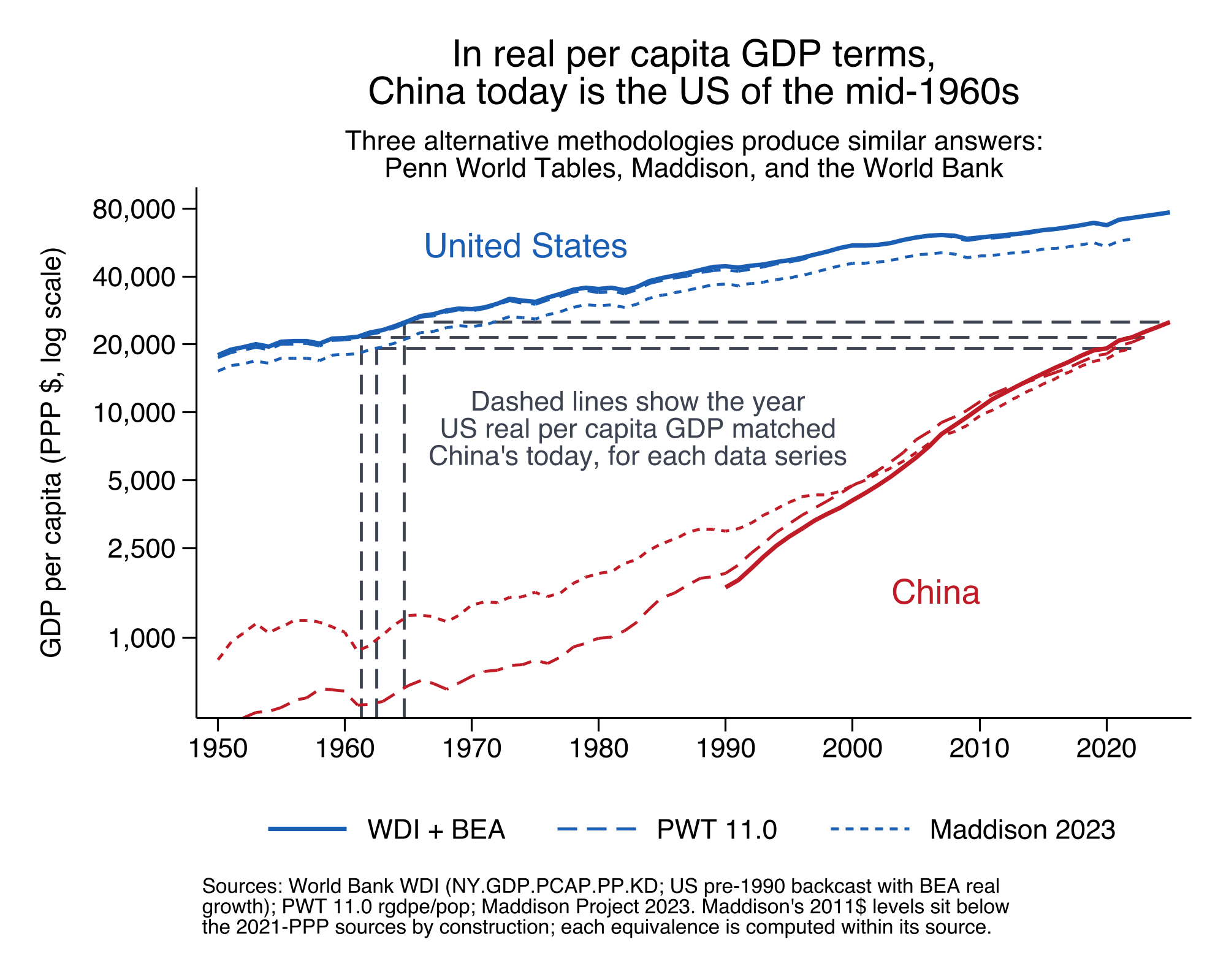
Chinese people today are probably poorer than Americans were in 1964 – though it’s unclear how much
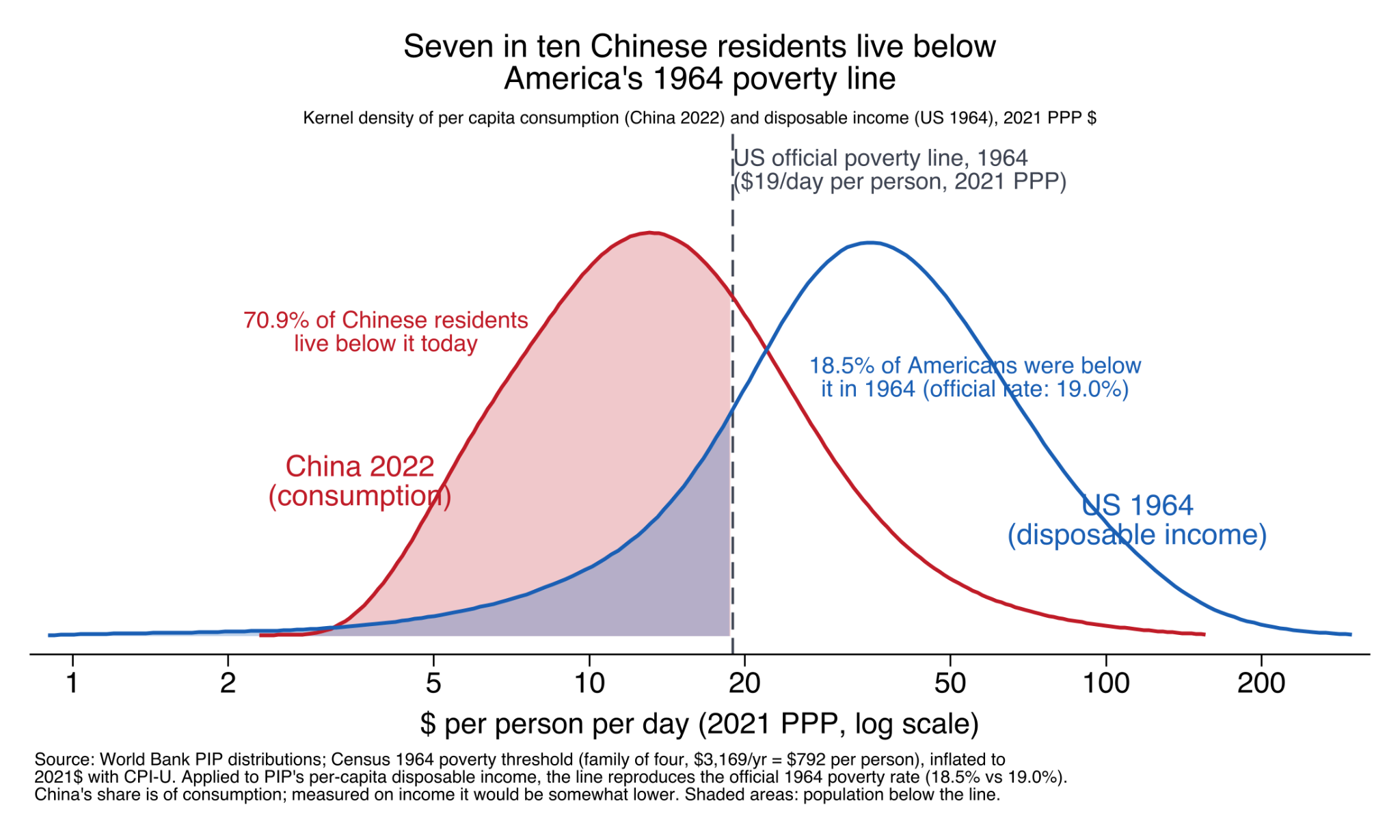
To track Johnson’s war on poverty, the Social Security Administration defined a poverty line at roughly $2.17 in daily pre-tax income per person – just under $20 today. At the time, just under 20% of Americans lived in poverty by that definition.
The closest comparison we can make for China relies on consumption, not income, a fudge which is common in global poverty measurement but probably understates China’s real performance somewhat. Nevertheless, the contrast is clear. Over 70% of Chinese people live on less than $19/day in PPP terms.
That’s a huge gap, but it may not tell the entire story.
My colleague Oliver Kim wrote a while back about how part of the mystery of China’s low consumption share of GDP – which underlies these poverty outcomes – is an artifact of measurement. There are signs that GDP is overestimated, and consumption is underestimated, a point Nick Lardy at PIIE has made before. Perhaps the best evidence for higher-than-reported Chinese consumption comes from a report by the China Finance 40 Forum, a Beijing think tank. The table below draws largely from that report, and juxtaposes it with comparable figures for the US circa 1964.
Setting aside messy issues of price deflators and purchasing power indices, Chinese people eat more and buy more consumer durables than Americans did in LBJ’s time – with the notable exception of cars. Housing is the main area where they are relatively deprived: China’s famous high-rise apartment blocks are not as spacious as suburban American houses.
Table: US vs Chinese consumption using physical metrics
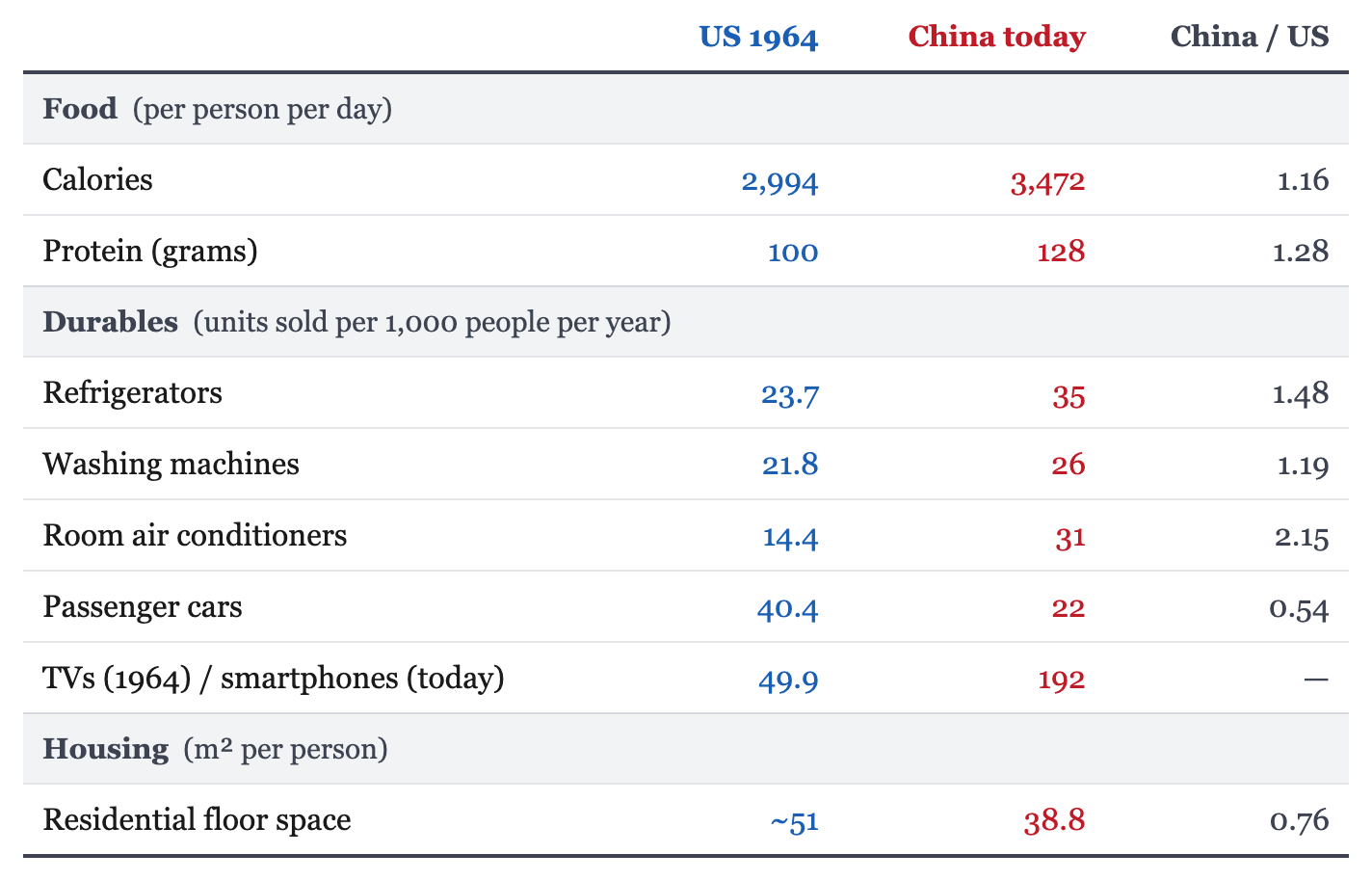
Sources: US 1964 — FAO food balances via Our World in Data (calories, protein); Statistical Abstract of the United States 1966, Tables 819 and 1194 (factory sales/manufacturers’ shipments of cars and appliances, TV production; US population 191.9 million); Moura, Smith & Belzer (2015, PLOS ONE) (floor space, whole housing stock, ±10 sq ft). China — FAO via OWID (food, 2022) and Yu Fei & Guo Kai, “China’s Consumption Is Not Nearly as Low as It Appears,” CF40 Institute, July 2025 (durables ~2023, floor space 2020). The TV/smartphone row is not like-for-like across periods.
Chinese wages relative to GDP are very low by Western standards, but similar to other East Asian growth successes
As Biden economic adviser Brian Deese noted after leaving the White House, Chinese “workers are paid a smaller share of what they produce than in most maturing economies.” The word “maturing” is doing a lot of work here, but the answer seems clear regardless.
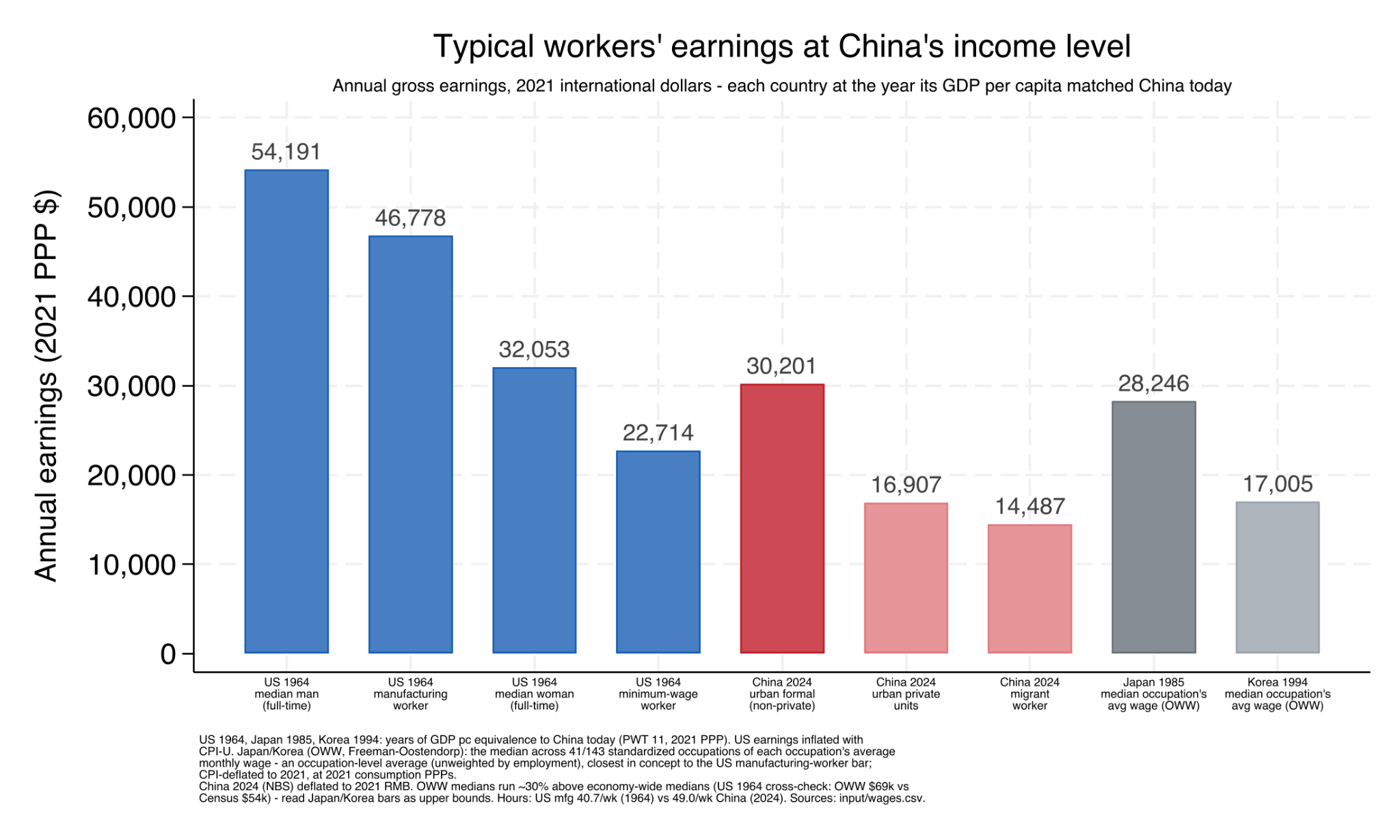
There’s no doubt that Chinese workers today earn far less than their American counterparts, even 60 years ago. According to published NBS statistics from China, public sector workers fare best, earning about $30k a year on average in real (PPP) terms. That’s about 60% of the median male worker in 1964 America, and only slightly behind the median female worker. Outside the public sector, it’s more bleak. The average private-sector employee in China today is earning substantially less than US minimum wage circa 1964.
Venturing into more ambitious counterfactuals, Robert Lighthizer, Trump’s first-term trade representative, told the House Select Committee on the CCP in 2023 that
“China’s mercantilism comes at the expense of Chinese workers, who face lower wages and living standards than they would under a more balanced trade regime...”
Lighthizer’s assertion assumes that the spectacular wage gains that Chinese workers have experienced over decades would have occurred in the absence of that “mercantilist” system.
Is that true? Or has China’s mercantilist been responsible for its remarkable growth?
China’s low wages relative to GDP are pretty typical for fast-growing East Asian economies pursuing an export-led manufacturing model. The Occupational Wages around the World database put together by economists Richard Freeman and Remco Oostendorp shows wages in both Japan and South Korea at similarly low levels when they were at similar levels of GDP.
Arguably, comparing wages to GDP at a point in time is the wrong benchmark. The whole premise of this debate is that China produces “too much” GDP, in the form of investment and net exports, relative to its overall level of development. The more relevant question is whether from a given starting point, Chinese workers would see bigger gains under a different system.
Chinese people today enjoy more and better public services than Americans did in 1964
Another common complaint in the West, and among plenty of Chinese economists too, is that the Chinese welfare system is too stingy.
Jumping into the mind of the great leader himself, Paul Krugman summarized the standard view in 2024: “Xi views American-style consumption as wasteful, and fears that providing too much state support to households could encourage ‘welfarism.’” This line of concern was echoed recently by former Biden official Brad Setser in an interview with Ezra Klein, where he praised Lighthizer’s trade stance under Trump I, and noted that
“China actually has a rather thin system of social insurance... Personal income tax collections are like 1% of China’s GDP. It’s 8% here…. The basic retirement benefit that anyone in China gets, no matter what your residency status, is like tens of dollars a month. It’s really, really trivial.”
Contrary to this view, China spends more on social services today than America did at a similar per capita GDP level. Social welfare spending broadly defined is about 14 percent of GDP in China today, compared to just under 12 percent when LBJ took office.
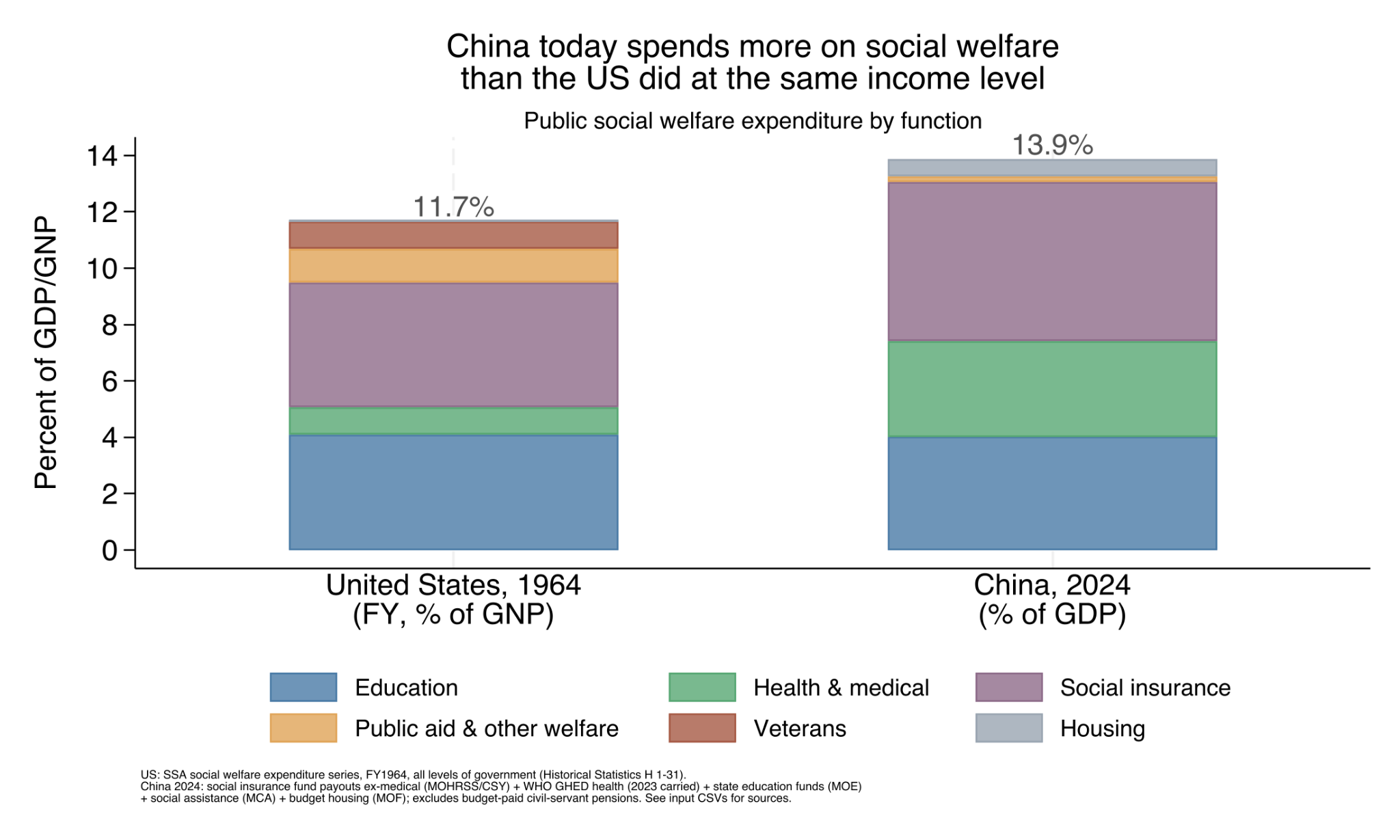
Education expenditure was pretty comparable in 1960s America compared to contemporary China. But the system was more expensive on a per pupil basis, so reached fewer people. Tertiary enrollment in 1964 was 28.7 percent, compared to 60.8% in China per recent dat.
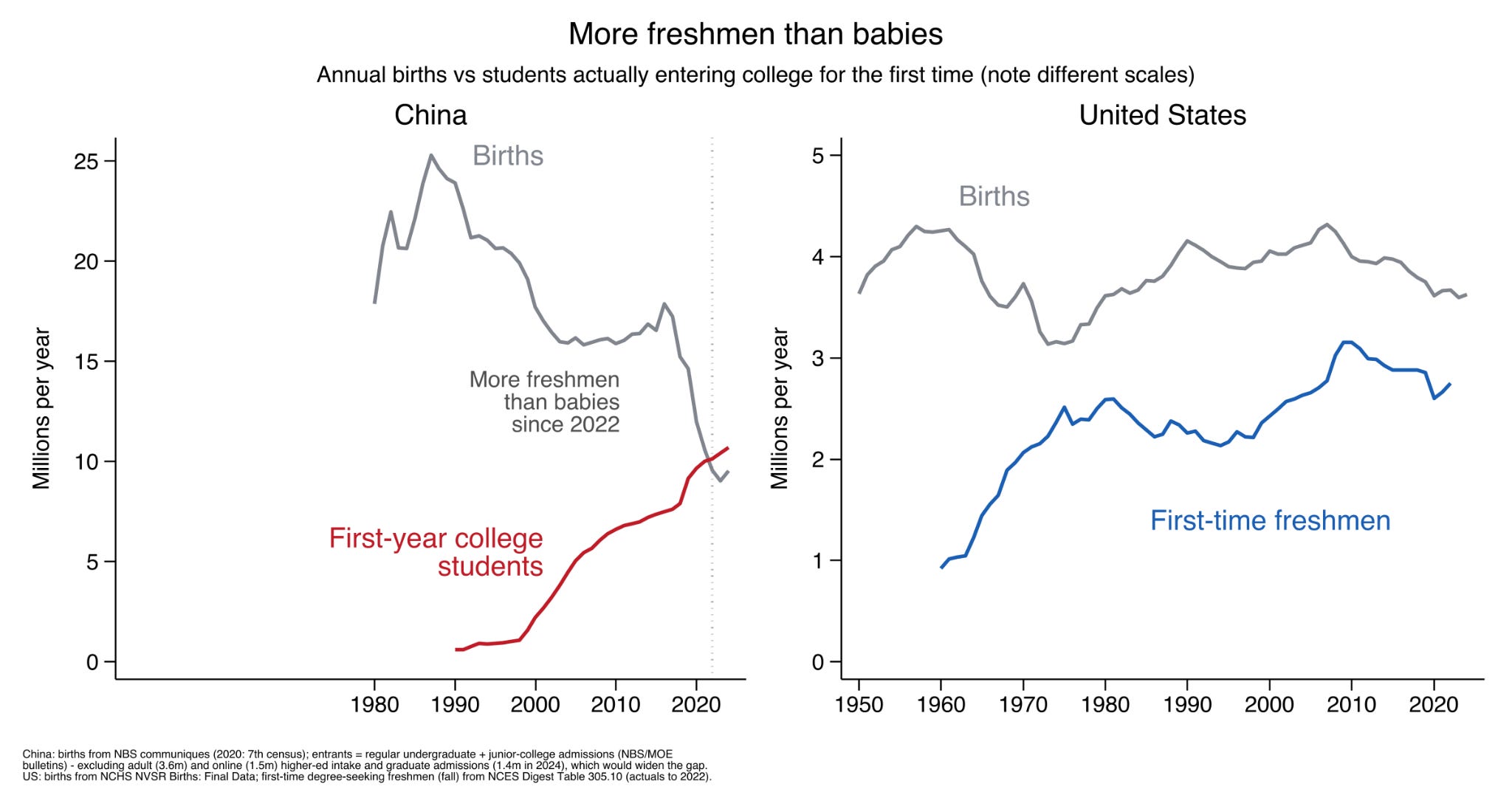
The boom in China’s college enrollment looks particularly dramatic juxtaposed with its fertility collapse. As a colleague at Peking University noted when showing me around the campus: there is no choice but for Chinese universities to shrink. As of 2022, the number of first year college students was larger than the number of babies born in all of China. Even if they all go to college, enrollment will decline.
Contrast that with 1964 America, which had college seats for only about a third of babies born that year. Even fast forwarding twenty-some years to when those kids actually reached college age, and there were only places for about three-fifths.
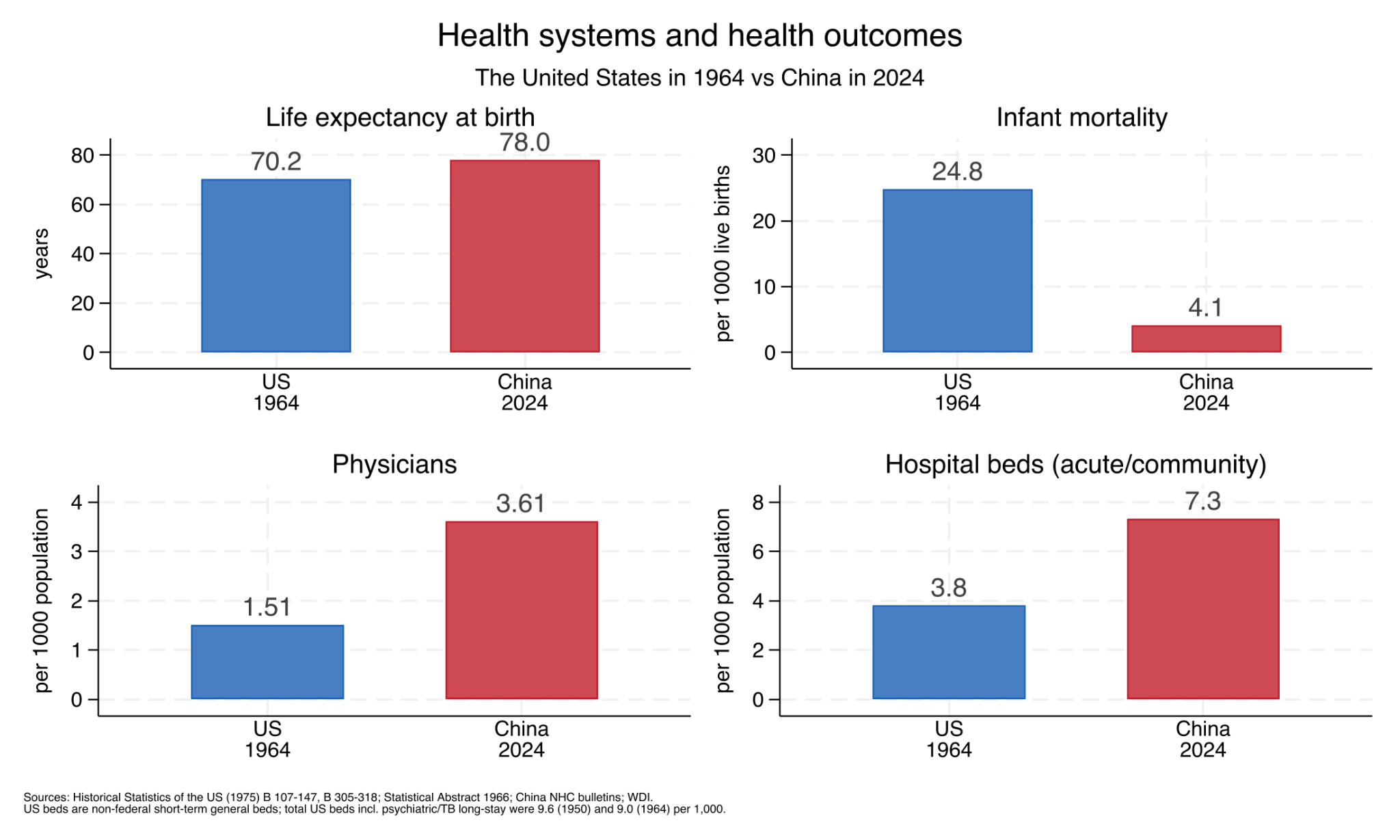
Healthcare is where China actually surpasses America’s spending patterns circa 1964. And that translates into better health as well.
Given global improvements in health technology – from new vaccines and drugs to MRIs and beyond – it’s no surprise that Chinese life expectancy today (78 years in 2024) exceeds Americans’ life expectancy at a similar GDP per capita (70.2 in 1964), and infant mortality in China is just 4.1 per 1000 live births, compared to nearly 25 deaths in Lyndon Johnson’s America. But again, the whole world has seen pretty rapid increases in life expectancy, driven largely by declines in infant mortality, so there’s a time effect here apart from any difference in health systems.
That said, it’s not just technological improvements that explains the China-US gap. China also boasts 3.6 physicians per 1,000 residents compared to America’s 1.5 in 1964, and has nearly twice as many hospital beds relative to its population. So the health system is simply bigger and more generous in some respects than America was at a similar income.
Before Medicare and Medicaid launched in 1965, about 78% of Americans had private hospital insurance of some kind, per the Health Insurance Association of America (which was higher than survey estimates). By contrast, 94% of Chinese people today are covered by basic public health insurance – though that coverage is indeed pretty basic.
Chinese growth has been good for Chinese households – perhaps more so than in America
Any defense of the Chinese economic model from a worker perspective hinges on wage increases over time, not their meager level, and the extent to which the fruits of world history’s greatest economic growth miracle have trickled down to the masses.
The FT’s Martin Wolf is a good example of many people’s skepticism: .
“Is this good valuable GDP, by which I mean GDP that produces now or in future welfare for the Chinese people, or the GDP which consists of creating stuff which will actually never be useable and that’s really difficult to tell. Obviously, a lot of it has been the latter and there’s no doubt that China has got much better off - there’s no doubt. But quite a bit of it has also been the former and that is always the question.”
As Wolf notes, Chinese leadership sometimes voices similar concerns. But the data doesn’t really bear them out.
In America, much has been made of the disconnect between economic growth and household earnings. Before Reagan’s arrival in the 1980s, median household income tracked GDP growth roughly one-for-one. Post 1980, that relationship fell apart.
In China, the story is roughly the opposite: the link from growth to wages and household consumption has been strong and getting stronger over time.
Formal wages in China have basically kept pace with economic growth for the last 30 years, or even surpassed GDP growth. The elasticity of median household consumption with respect to GDP in China started off low in the 1990s and early 2000s, about 0.7. Since then it’s picked up to almost 1.2 – implying consumption for the median Chinese person is growing faster than the economy as a whole. That’s also true for formal wages. The one group which has notably not kept up is migrant workers, whose wages show a growth elasticity (relying again on official NBS figures) of about 0.7.
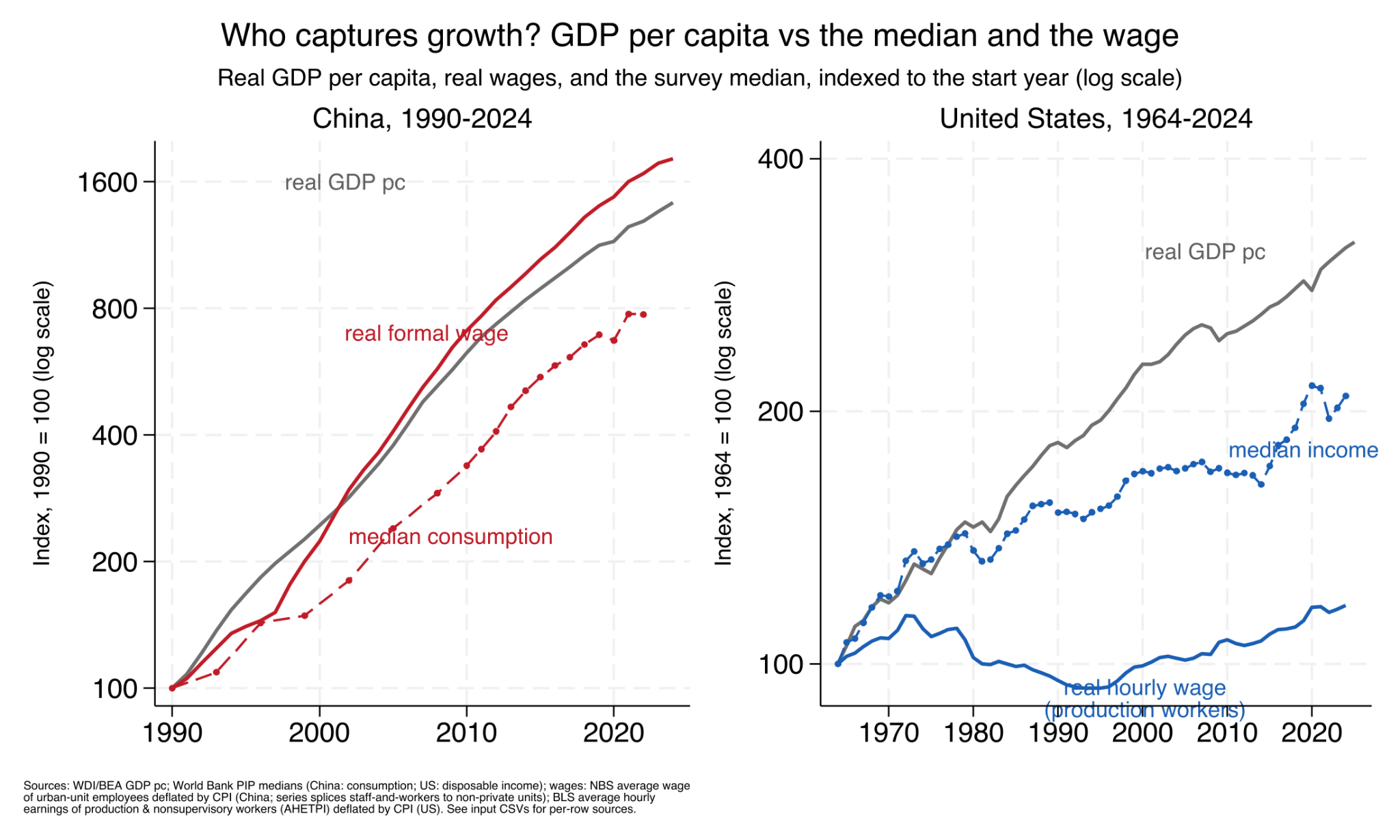
In short, household gains from growth in China today look similar to America’s post-war glory days, and are much clearer than in America today. There is no denying that Chinese workers get a smaller share of the pie. But their income and consumption gains track growth remarkably well.
And again, regardless of how growth is shared, there has just been a lot more growth to go around in China. From the 1960s to today, Americans saw median incomes roughly double in real terms. China achieved that same feat (using median consumption as the metric) in less than a decade, and more than once.
A win-win retreat from globalization?
In sum, China’s population has a lot to lose. Its per capita GDP is roughly where America’s was when LBJ launched the war on poverty. Yes, Chinese people remain poorer and earn lower wages, but have access to more and better social services, and have enjoyed the gains from growth in a way Americans (perhaps rightly) feel they no longer do. The real material gains China’s model has produced for its population are unrivaled, and any suggestion that a different model would do better bears an enormous burden of proof.
Of course, Chinese welfare isn’t the only consideration. As a development economist, I worry a lot about whether the Chinese export juggernaut is currently making it more difficult for other, poorer developing countries to climb the traditional ladder of development (see the recent piece by my friends Shoumitro Chatterjee and Arvind Subramanian, or this by Wolfgang Krieger of Germany’s state-owned development bank). So there are a lot of normative issues unanswered here.
I don’t for a second think that a deeper appreciation of China’s social indicators is going to quiet American or European complaints about Chinese currency manipulation or lead Washington or Brussels to rollover and accept the death of whole industries. Nor should it, necessarily.
From a positive perspective, though, one can understand why Chinese policymakers might look at these numbers and wonder about the wisdom of deviating from the status quo.
In an era of national security rivalry and massive and persistent global trade imbalances, Katherine Tai and others have good grounds to question the econ 101 promise that free trade is always win-win. But there is also no economic theorem guaranteeing that a move toward autarky will be win-win either. Rectifying global imbalances may produce losers, many of them Chinese people who remain poorer than Americans today.
Excellent write up. I totally agree on emphasizing the fact that births are now lower than college entrance numbers. This will lead to competition among universities and cities funding universities, because any city without a university will decline as talented youth move out, and any university without enough students will get closed in China.
Just one note: the often repeated claim, China's GDP would be lower than stated, is entirely dependent on what even gets measured in GDP. China still does include less financial "services" into its GDP count than Western countries, nor does it add estimates for black market transactions. On that side GDP would actually be quite a bit higher, if measured the European way.
I like this piece and you're making a good, broad point with some interesting (and clever) analysis and comparison. Of course, China's past growth and distribution is no guarantee of the future and there's a credible argument that maintaining China's growth in the future might require turning toward more domestic consumption and services.
On the question of welfare systems and safety nets I was really shocked by a poster I saw recently advertising American social/public benefits including "unemployment insurance, workers compensation, disability....food stamps, low cost or free school meals, home energy assistance...medicaid, at-home care...." This was targeted toward investors interested in EB-5 visas. I'm not actually sure if visa holders are eligible for those benefits, but it was quite striking that that was a big selling point for, presumably, rich Chinese.
That could be saying a lot about the sense of insecurity, even among relatively wealthy Chinese.
See here: https://popular.info/p/trump-labor-secretary-nominee-pitched