

A few weeks ago, my family and I relocated from China to South Africa. So far we love it, but there are tradeoffs. Moving from Beijing’s technological marvels, low crime, and sedate politics, to roughly the opposite here outside Johannesburg, it’s tempting to get a bit cynical about the relationship between democracy and development.
For decades, the Chinese political system rewarded provincial leaders for economic growth. In African politics, by contrast, “neopatrimonialism” is still a pretty dominant explanation for how things work: a veneer of formal legal institutions is combined with executives who wield immense discretionary power. They dole out state resources to reward political allies and punish political enemies, with no incentive to invest in public goods.
Following the news from here in Southern Africa over the last couple years, I’m more optimistic.
Voters reward growth, especially in poor countries
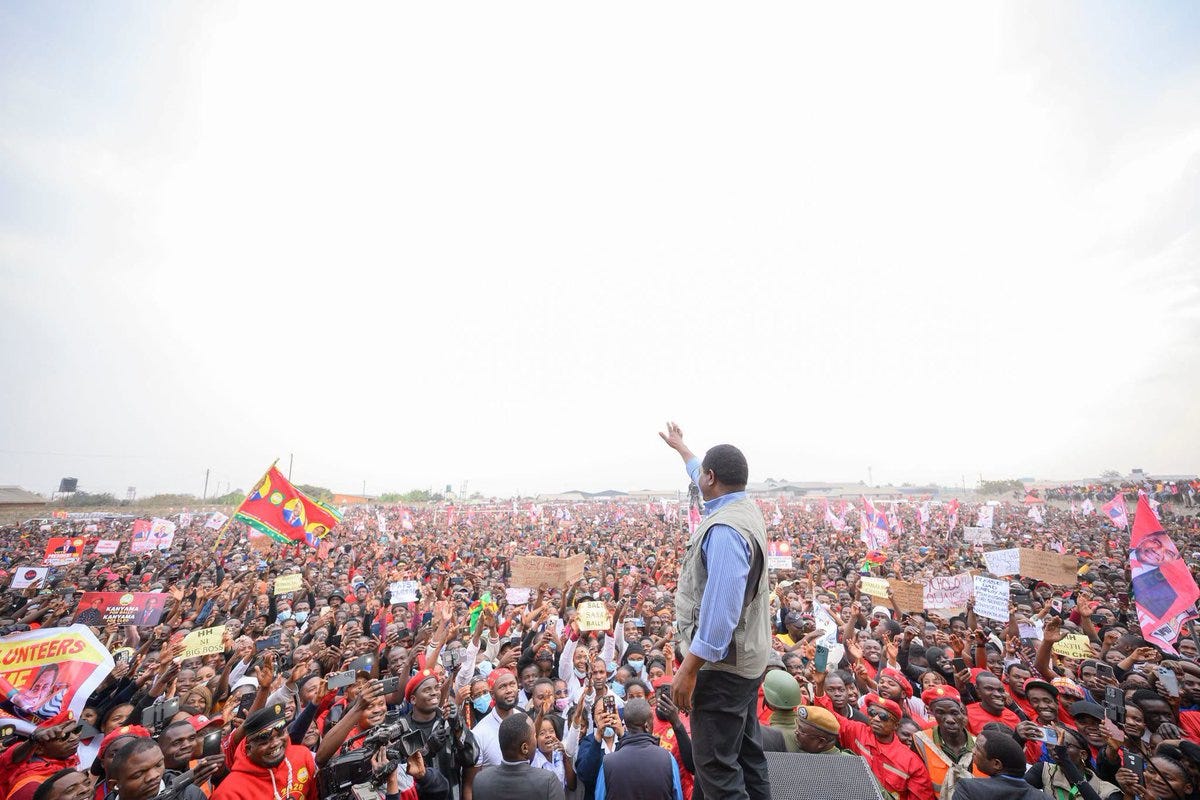
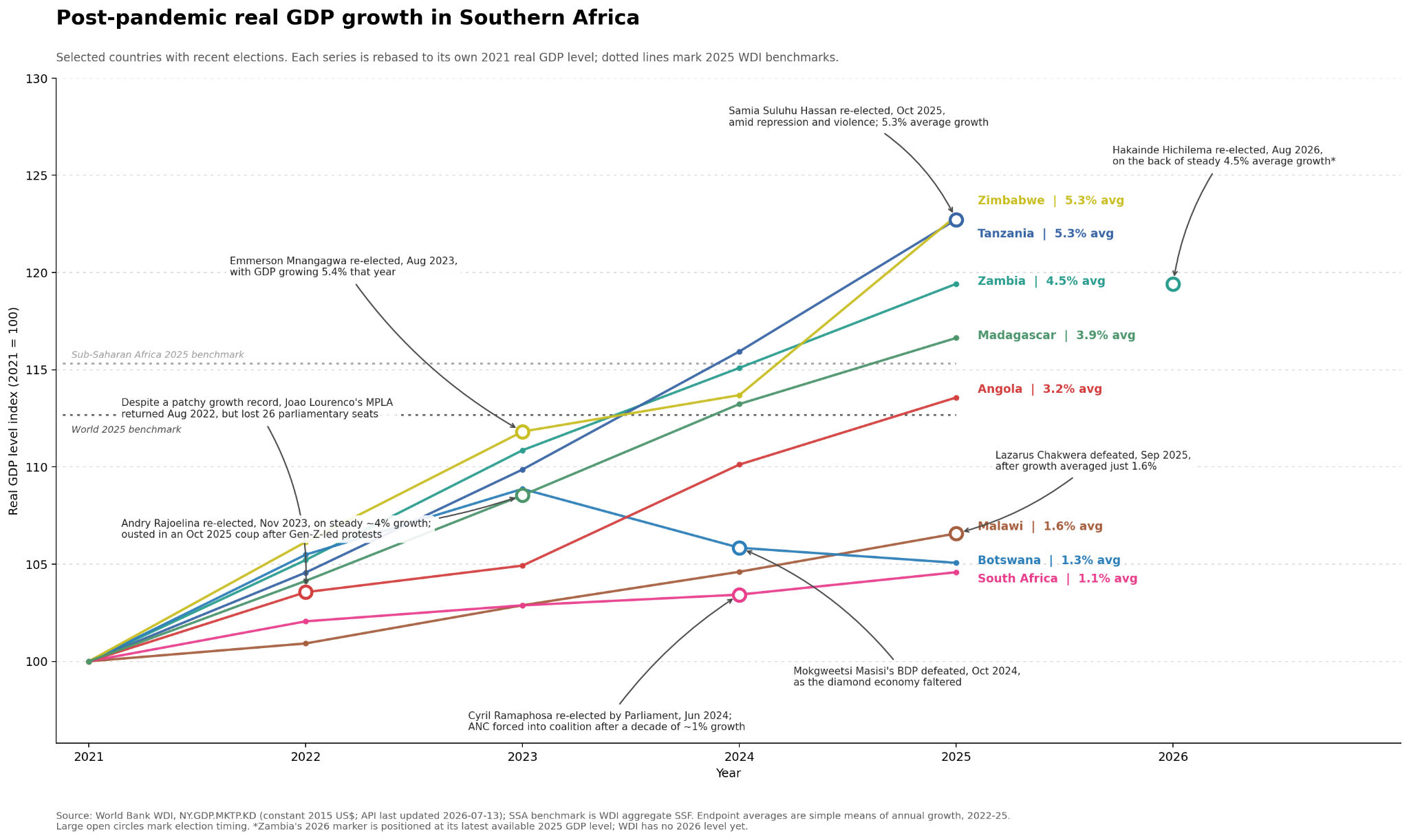
My optimism got a boost with this week’s election news from Zambia, where a strong economic track record appears to have propelled Hakainde Hichilema to reelection. While there are plenty of concerns about the harassment of the opposition during the campaign, tentative results give Hichilema 60% of the vote. HH has become something of a darling in the west for opening up FDI in mining and restoring macroeconomic stability after Zambia’s 2020 sovereign debt default. That recipe was enough to deliver steady economic growth around 4.5 percent since the pandemic slump.
Zambia is less of an aberration than you might think.
Contrary to the view that poor countries’ electorates fail to reward economic growth, the cross-country empirical literature actually finds exactly the opposite. Across democracies in the developing world, Brender & Drazen (AER 2008) found that 1 percentage point faster economic growth over a leader’s term is associated with a 7 to 9 percentage point higher probability of reelection. Strikingly, that effect is totally absent in developed economies.
Growth failures also have consequences
For leaders in southern Africa who lack Hichilema’s strong economic track record, things have not gone so well. As Sishuwa Sishuwa put it for the African Arguments blog, “while Zambians may be poor at choosing good leaders, they are good at removing bad ones.”
It seems Zambia’s neighbors also know how to punish slow economic growth. The graph below plots election margins against economic growth rates over the 5 years in the run-up to elections. A regression line through 8 data points is a bit silly, but if you squint, it does seem Southern Africa fits the global pattern of a positive electoral payoff to growth.
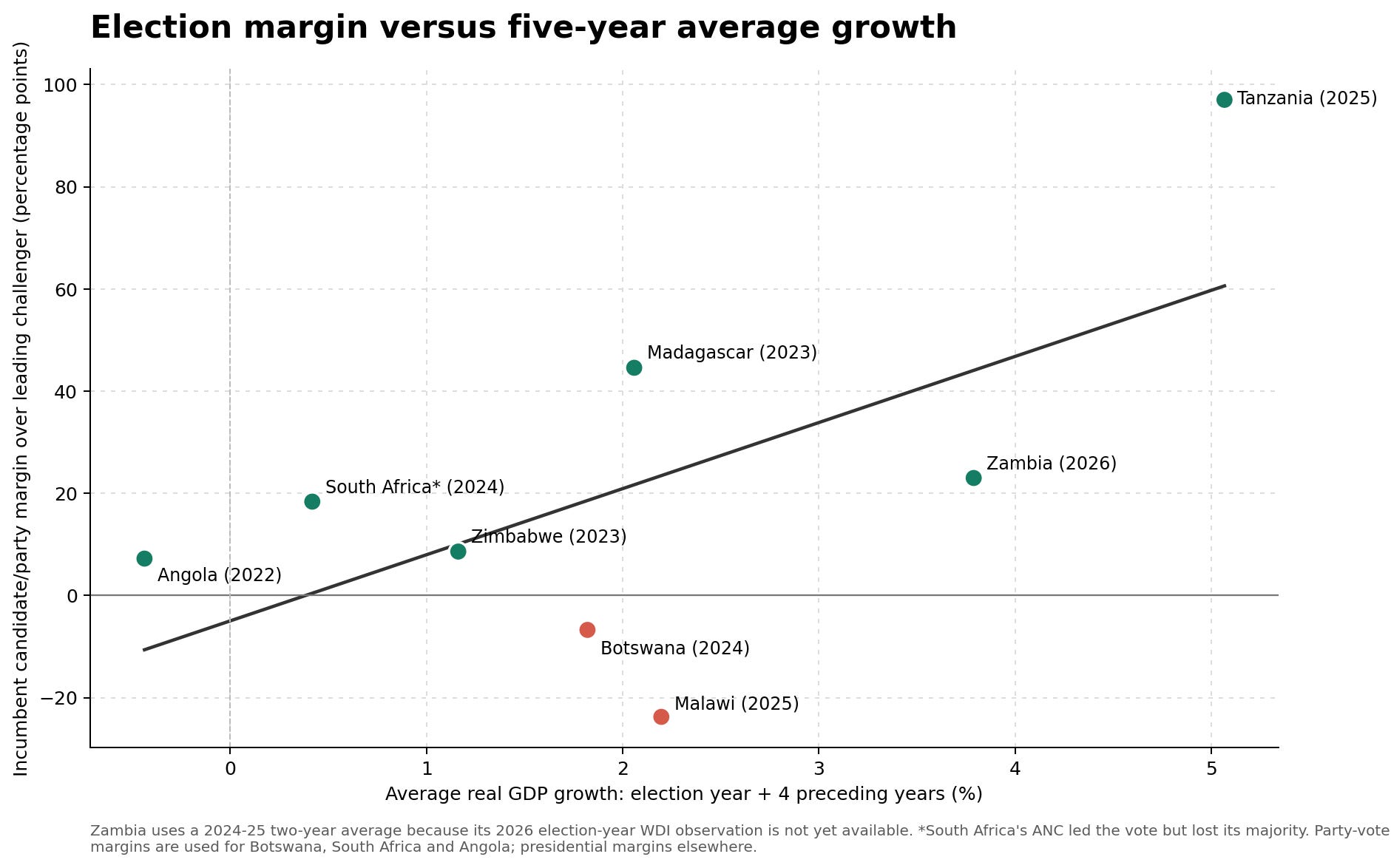
Take Malawi, for instance. Prior to elections last year, Malawi had suffered multiple years of growth that barely scratched 2 percent, punctuated by a forex crisis, queues for fuel, and an El Niño famine in the south of the country. In September, incumbent Lazarus Chakwera suffered defeat at the polls to his longtime rival Peter Mutharika.
In Botswana, elections in 2024 saw the end of the BDP’s 58-year reign, with incumbent Mokgweetsi Masisi losing to Duma Boko as the country’s diamond-driven economy falls to synthetic rivals and falling Chinese demand for luxury goods. As political scientist Bontle Tumediso wrote in African Affairs, “Contrary to the common adage, diamonds [aren’t] forever,” and amid 27% unemployment, voters blamed the BDP for failing to diversify the economy.
The region’s biggest economy, South Africa, has seen particularly dismal economic growth for over a decade, hovering around 1 percent per annum with the exception of the Covid slump and brief recovery. In 2024, Cyril Ramaphosa returned to the presidency, but the ANC lost its majority and was forced into a coalition with the DA.
Angola is closest to a clear exception to this pattern in southern Africa. João Lourenço has some of the hallmarks of Hichilema, but has been less successful in spurring growth. “While foreign investors hail Lourenço as a ‘courageous’ great reformer, hunger, poverty, and popular dissatisfaction are increasing”, noted Jon Schubert and Gilson Lazaro before the 2022 elections. In the end, Lourenço was victorious despite his patchy growth performance. It was, however, his MPLA’s weakest showing in the post-war period, losing 26 parliamentary seats.
This pattern doesn’t always hold under conditions of complete electoral probity
Even autocrats are accountable to somebody, sometimes. Extending the cross-country analysis mentioned above, Burke (2012) confirms a link between growth and regime survival in a sample spanning both democracies and autocracies in the developing world, with no real difference between the two.
In that vein, nobody was shocked that Zimbabwe’s Emmerson Mnangagwa was reelected in 2023, officially with 52.6 percent of the vote. But for its faults, even the World Bank credited the ZANU-PF government for generating “one of the fastest-growing economies in the Southern African Development Community” in 2021, 2022, and 2023.
Tanzania’s elections late last year were marred by violence, and opposition parties were mostly banned. So, yes, take the Tanzania vote margins in the graph with a big grain of salt. Nevertheless, looking at Tanzania’s macroeconomic performance, it should come as no surprise that Samia Suluhu Hassan and CCM – which has ruled since independence – cruised to reelection. Samia achieved that feat on the back of 5 percent growth, putting most regional neighbors to shame. CCM elites seem to be hoping for a Chinese-style political bargain, where civil liberties are held in abeyance as long as they can deliver economic progress.
Madagascar is a messier story, admittedly: incumbent Andry Rajoelina was reelected in November 2023, on the back of stable 4 percent growth (again, with a Covid exception). But less than two years later he was ousted amid Gen Z protests about the long-run economic travails Madagascar has faced – falling gradually behind its regional peers over decades – culminating in a military coup in late 2025.
Punishing failure is not the same as producing success
To avoid overstating the case here, it’s worth noting that none of these growth rates are that impressive. Zambia’s 4.5% growth with 2.8% population growth means a doubling-time of 42 years for per capita incomes. China achieved that in 7 years in the mid-2000s.
Repeatedly punishing failure is also not the same as producing success. Malawi has seen an amazing run of party turnover in the president’s mansion, reflecting in part voter dissatisfaction with the country’s long-term economic slump. But those switches have failed to produce much real change. It remains to be seen whether getting its nose bloodied in the last elections will lead the ANC to make any radical changes, and similarly Duma Boko’s government in Botswana still faces the harsh reality of the declining diamond market.
But there is some small consolation in the signs that voters are paying attention. Electoral politics and pro-growth reforms do not seem fundamentally at odds, even in some of the world’s poorest countries.