

An interactive version of this post — with live widgets instead of static images — is on the Coefficient Giving website, along with the full calculator and the technical note.
“Is there some action a government of Nigeria could take that would lead the Nigerian economy to grow more like an AI-powered United States’ or China’s? If so, what, exactly? If not, what is it about the ‘nature of Nigeria’ that makes it so? The consequences for human welfare involved in questions like these are simply staggering: Once one starts to think about them, it is hard to think about anything else.” — the spirit of Bob Lucas (1988)1
In 1800, Mali’s per capita GDP was roughly 5x smaller than Britain’s. Today it is roughly 25x smaller.2 The Industrial Revolution accelerated growth in the UK and the benefits of the new tech eventually reached the whole world. But the process has taken so long that, two centuries later, the gap is still 5x larger than it was before the new tech arrived.
More and more economists are taking seriously the possibility that AI will cause a rapid acceleration of growth in frontier economies.3 Investors are betting trillions on AI. For their bets to be right, AI companies need to generate even more trillions in revenue, which would imply a big growth acceleration in frontier economies. The economic consequences are serious enough that the Fed just launched a high-profile task force on AI and the economy. So it doesn’t seem crazy to think that AI can really accelerate frontier growth. What happens to Mali this time?
This post argues that Mali, and all non-frontier economies, are likely to be left behind, at least in the initial phase when frontier economies are rapidly becoming more automated.4 The broad argument depends on two simple and, in my opinion, fairly reasonable assumptions:
AI accelerates frontier growth. At least in the period immediately after the arrival of Transformative AI (TAI), the growth rate of frontier economies increases. That’s the period I focus on here, and I call it the “detachment window.”5
Poor countries will also see a boost to growth — but there will be a lag. For reasons I will discuss below, poor countries lag behind in AI adoption in productive activities, so the productivity increase due to AI arrives in non-frontier economies with a lag.6
Surprisingly (to me at least), these two ingredients are sufficient to conclude that the GDP gap between frontier and non-frontier economies increases in the detachment window. You can see the math in the technical note. The intuition is best presented via an image:

Figure 1. On the flat, the gap is constant; when the leader hits the downhill, the same 30 seconds becomes a growing gap. The frontier is the leader; the slope is accelerating growth; the head start is the tech adoption.
Have you noticed in the Tour de France that when riders reach a downhill stretch, the distance between them tends to open up? That’s because the slope accelerates the bikes, which turns a fixed gap in time into a growing gap in space, even if they are pedaling equally hard. Here the leader is the frontier economy, TAI is the downward slope, the fixed gap is in years for adoption of AI in productive activities, and the gap is in GDP.
The rest of this post presents a simple economic model that helps me justify these assumptions and quantify how much the gap opens up.
The stakes are enormous. In the central scenario, delayed adoption leaves average incomes in the developing world at the end of the window about a fifth of what they would have been with no lag. Each year of faster productive AI adoption in lagging economies is worth about $42.6 trillion in present-value income (more than a third of the world’s GDP), or the equivalent of saving 115 million lives if we adopt Coefficient Giving’s standard methodology.
If you are skeptical of the assumptions, you can change all the parameters in this calculator. You can also download the source code here.
A simple model of takeoff in frontier economies
Think of the economy as a series of tasks: drive the truck, weld a joint, file taxes, make Doritos Screamin’ Sriracha, sell Doritos Screamin’ Sriracha at Dollar General, etc. Each task can be done by either a person (L, for labor) or a machine (K, for capital), and all tasks are combined using a Cobb-Douglas aggregator (a staple of economics) to get us total output (Y). A bit of math gets us to:
To see the math, check the accompanying technical note.
This is the tasks model, the workhorse of the automation literature.7 Here f is the fraction of tasks in the economy allocated to capital. Since f tasks are allocated to capital, (1 − f) tasks are left to labor. Capital has to perform f tasks, so the total amount of capital available to produce each task is K/f.
I think of an AI-induced growth takeoff in frontier economies as increasing f. This is not something I invented. In fact, I just copied the idea from one of the most cited papers on the economics of AI, Aghion, Jones, and Jones. As AI capabilities grow, machines become more capable of performing economic activities, so more tasks are allocated to machines, and the growth rate in frontier economies increases. In fact, in this model, the higher f is, the higher the growth rate.8
To calibrate the speed of growth we first need to assume a trajectory for f. I assume f follows an S-shaped curve because that’s basically how all technologies spread (Geroski 2000). In the beginning, AI doesn’t exist and doesn’t drive automation. Then it’s invented. Then, as it gets better and better, tasks are automated at a growing rate. As we get closer to 100% of tasks automated, only the harder, more expensive tasks to automate are left. We’ve reached diminished marginal returns and f tapers off.
Maybe f never reaches 100%, as Alex Imas believes. That is, a number of tasks can be permanently left to humans. These can be heavily regulated tasks, like the final steps of getting a green card, or tasks where people have an intrinsic preference for humans, like yoga teachers or sports.
Once we have a shape and a cap, we can calibrate how long it takes for frontier economies to go from the current level of automation to the final level. Call that T.9 My central guess is 15 years, which is the mid-point between optimistic and pessimistic predictions related to the speed of automation of the US economy.10
Finally, to determine the full path of frontier growth, we need to set the speed of growth under full automation. I base that on Korinek and Suh 2024, where a fully automated economy eventually settles into growth of approximately 18% per year (more on this parameter in the last section of the post). The growth rate at the end of the detachment window then depends both on the maximum level of automation and the growth rate under full automation.
Step 1. Falling machine costs push the automation share f up an S-curve, and the model converts that share into a growth rate, side by side below. The key fact: the relationship is log-linear, so equal steps in f multiply growth by equal factors. Drag T:
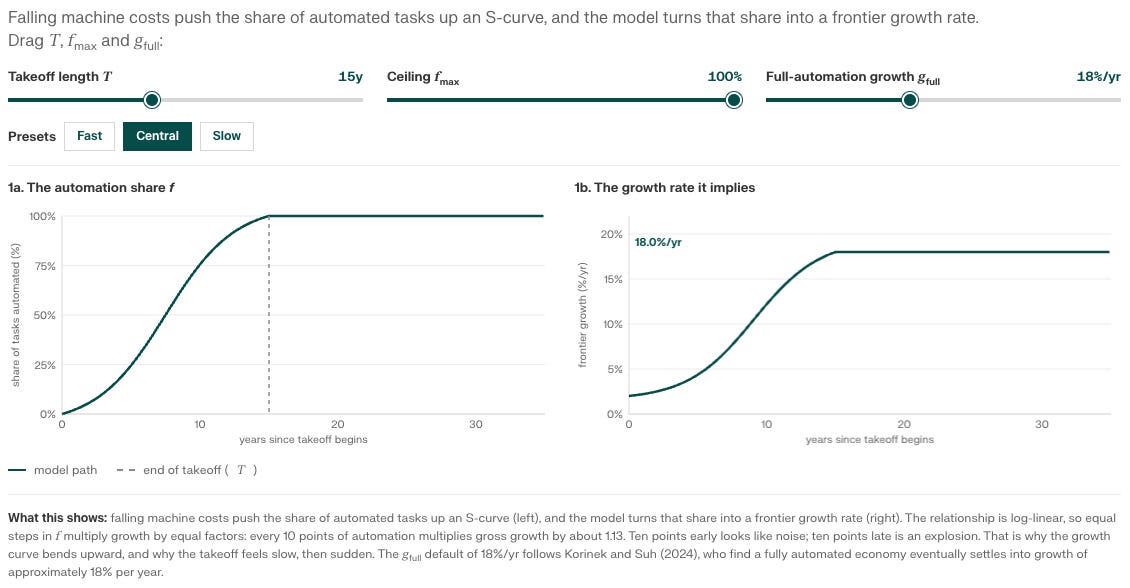
Every parameter behind these panels is exposed in the full calculator.
A rising tide lifts some boats faster than others
Today, the latest AI models reach poor countries quickly. My friend in Benin uses ChatGPT all the time (though getting advice on crypto trading might not be the most productive AI use-case). So shouldn’t f just grow at the same rate in lagging and frontier countries? Isn’t there a chance that poor countries adopt AI even faster than rich ones? Africa has more young people than any other continent, and they did overtake the US in the adoption of digital payments.
Unfortunately, my friend is just an exception that proves the rule. Using data on AI-related activity on Windows devices, this recent IMF paper finds that LLM use lags behind in poor countries.
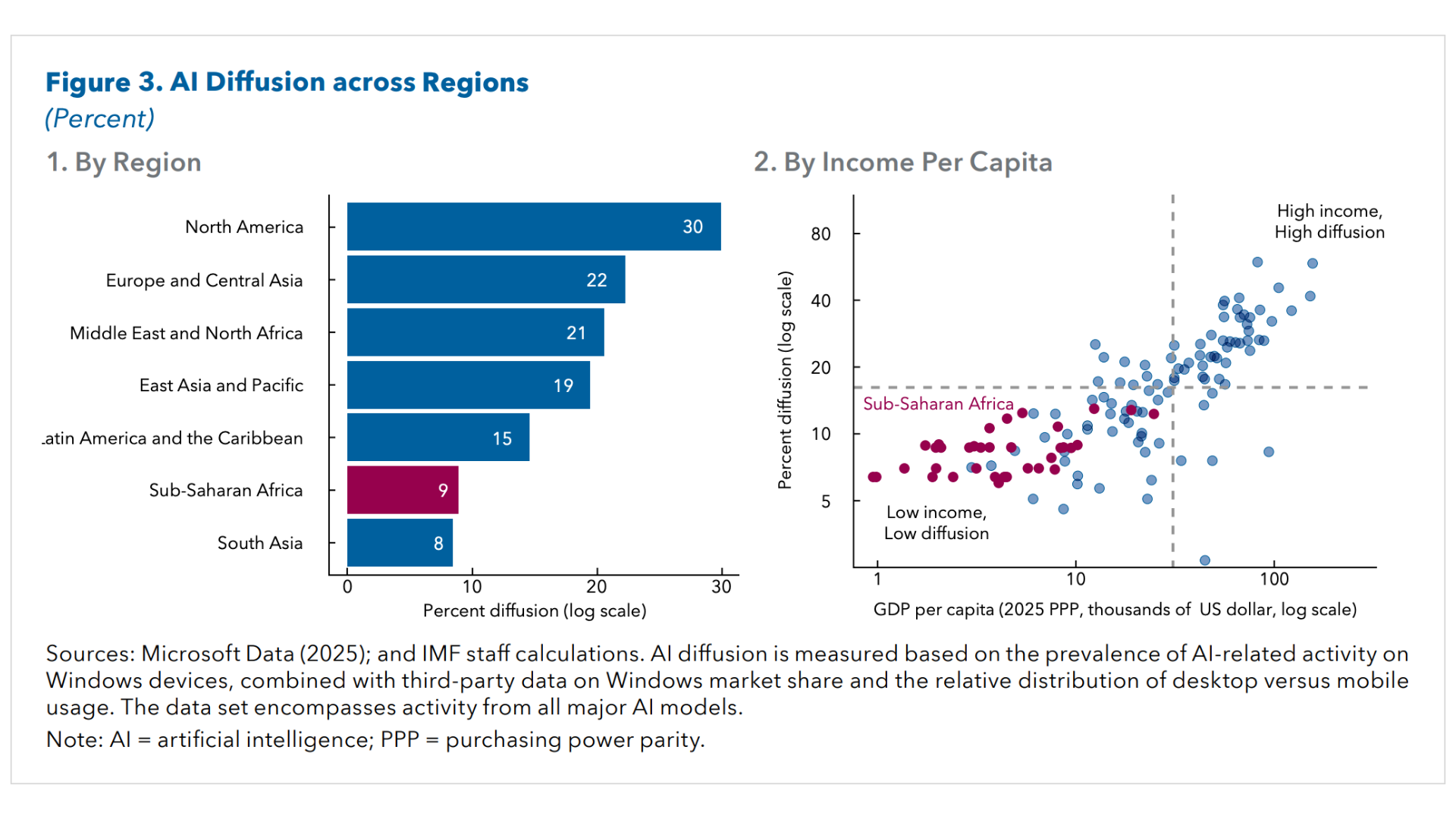
And I think that amidst a wave of AI-driven growth in frontier economies, the AI gap between frontier and non-frontier economies will not decrease. That’s especially true of AI adoption in productive activities – that is, in activities that actually generate money, move the automated fraction of the economy, and cause GDP growth. Here are the main reasons:
GDP of frontier economies relies more on cognitive tasks, and those will probably be automated first by AI. Increasing f means automating production, which involves both cognitive and physical tasks. AI is currently much better at cognitive than physical tasks. A high fraction of US GDP is in sectors with a high cognitive component, like banking, consulting, law, software, and biotech. Mali has a lot of GDP in agriculture and mining, where physical tasks are relatively more important. So the first wave of automation has far more surface area to work on in the US than in Mali.11
Automation costs money. The hard part of AI-driven automation is in physical tasks. Drones that spray fields, humanoid robots, and self-driving trucks are all expensive machines. Poor countries have little money to pay for them. They also face higher interest rates, so any investment project gets more expensive.
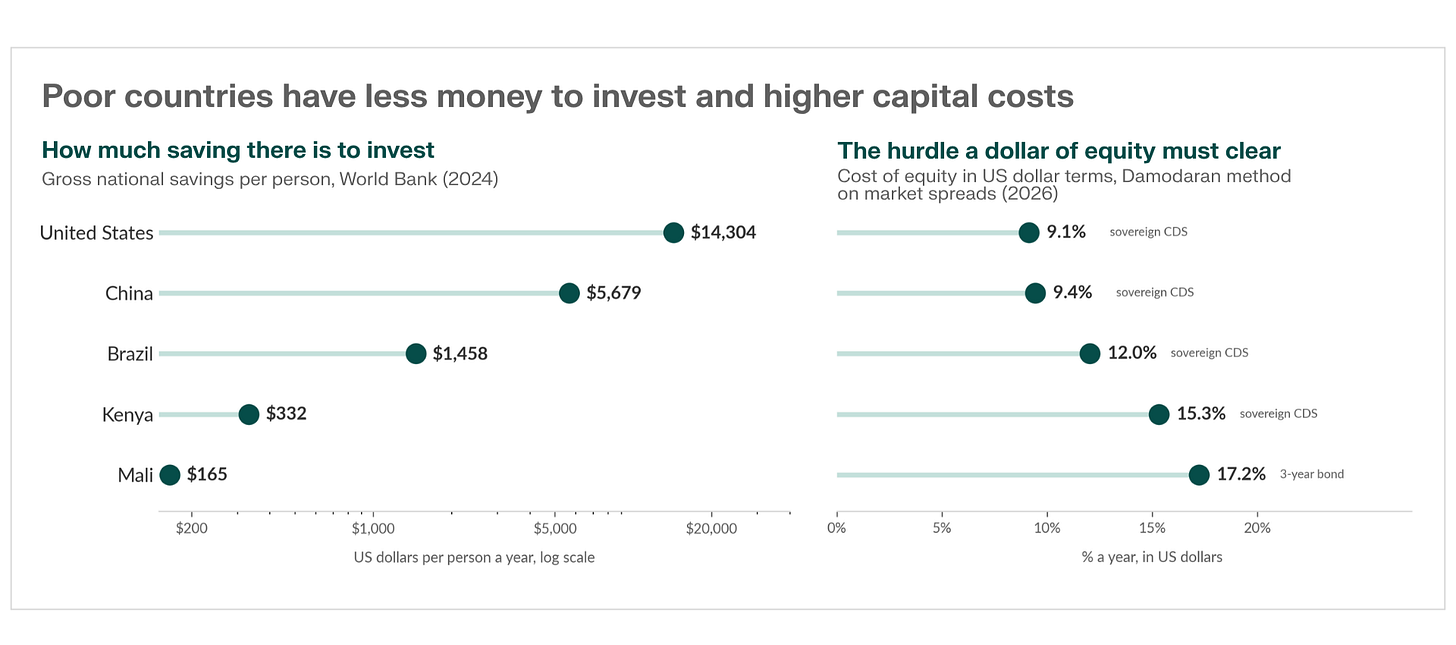
Source: Panel A: World Bank World Development Indicators, gross savings (% of GDP) and GDP per capita, 2024 (NY.GNS.ICTR.ZS, NY.GDP.PCAP.CD), retrieved 31 July 2026. Panel B: Aswath Damodaran, Country Default Spreads and Risk Premiums, updated 5 January 2026. Cost of equity in US dollars = risk-free rate in US dollars plus the country equity risk premium, at a beta of 1. Risk-free rate in US dollars = 4.67% US 10-year Treasury on 30 July 2026 less Damodaran’s 0.23% US default spread = 4.44%. Damodaran builds the country premium by scaling a sovereign default spread by the ratio of emerging-market equity to emerging-market government-bond volatility, a factor of 1.52. The spread used here is the traded one, not the one implied by the credit rating: Damodaran’s sovereign CDS premium for the United States, China, Brazil and Kenya, and for Mali, which has no CDS, its own 3-year CFA-franc Treasury bond at 8.17% (UMOA-Titres auction, 18 March 2026) less the 3-year German Bund at 2.56%, the CFA being pegged to the euro. Ratings would put Kenya at 18.4% and Mali at 20.3% instead; they agree with the market to within 0.2 percentage points for the other three. This is a hurdle rate for equity: a firm’s dollar borrowing cost sits below it and the sovereign’s below that.
In the period of AI-induced frontier growth acceleration, capital will likely flow uphill (from poorer to richer countries), raising interest rates in poor countries relative to rich countries and making it even harder to pay for these machines.12 (Lack of money is less of a factor in AI adoption for cognitive tasks, but it can be an issue. While people in poor countries can download a frontier LLM app for free, the price of tokens starts to bite at scale. In the US, AI-use bills are increasingly too big even for rich companies.)
Automation makes more economic sense when wages are high. Suppose a robot that replaces one worker costs $50,000 a year to own and run (after capital costs, maintenance, and power). In Seattle, the worker it replaces costs $65,000 a year, so automation saves the employer $15,000. In Lilongwe, a worker costs $2,000, so automation loses $48,000 a year. This is a stylized example, but the point is just that the higher the labor costs, the higher the economic gain from automation.13
Complementary inputs. Automation is more attractive if you have reliable and cheap electricity, internet connectivity, sensors producing data, skilled managers who can reorganize firms, etc. All these complementary inputs are more abundant in frontier economies. China already has a lot of robots making cars, so the next AI-powered robot can slot right in. If you are Zambia and have no car factories, making the AI-powered robot produce cars will require a lot of complementary investment.14
In the model, these reasons can be summarized by a single lag (D).15 That is, the poor country’s automation curve f is the frontier’s curve shifted right by D years. It’s not hard to see why. A task is given to a machine if, and only if, the cost of completing it with a machine is lower than with a human. We can map reason 3 into lower local labor costs in non-frontier economies, and reasons 2 and 4 into higher effective machine costs. Reason 1 affects the composition of tasks rather than the cost of a given task, and mapping it into my simple model would require additions making it significantly less simple, so I leave it out.
We can then conceptually model the arrival of TAI as a phase in which AI makes machines more and more effective at performing economic tasks, which is mapped as a steadily falling cost of completing tasks with machines. This single driving force causes the share of automation f to increase in both frontier and non-frontier economies, as more and more tasks flip from being overall cheaper with humans to overall cheaper with machines. I find it neat that a simple model, grounded in the literature, can generate increasing automation shares and growth in both frontier economies and non-frontier economies, but with a constant lag D separating them (check the technical note for details).
The model also gives a hint on how to calibrate the lag. D equals the machine-cost halving period times the (log of the) country’s cost disadvantage. For example, a country facing a 10x less favorable machine-to-labor cost ratio, with machine costs halving every three years, has a lag of about 10 years.
You can play with machine-cost halving periods and machine-to-labor ratios here:
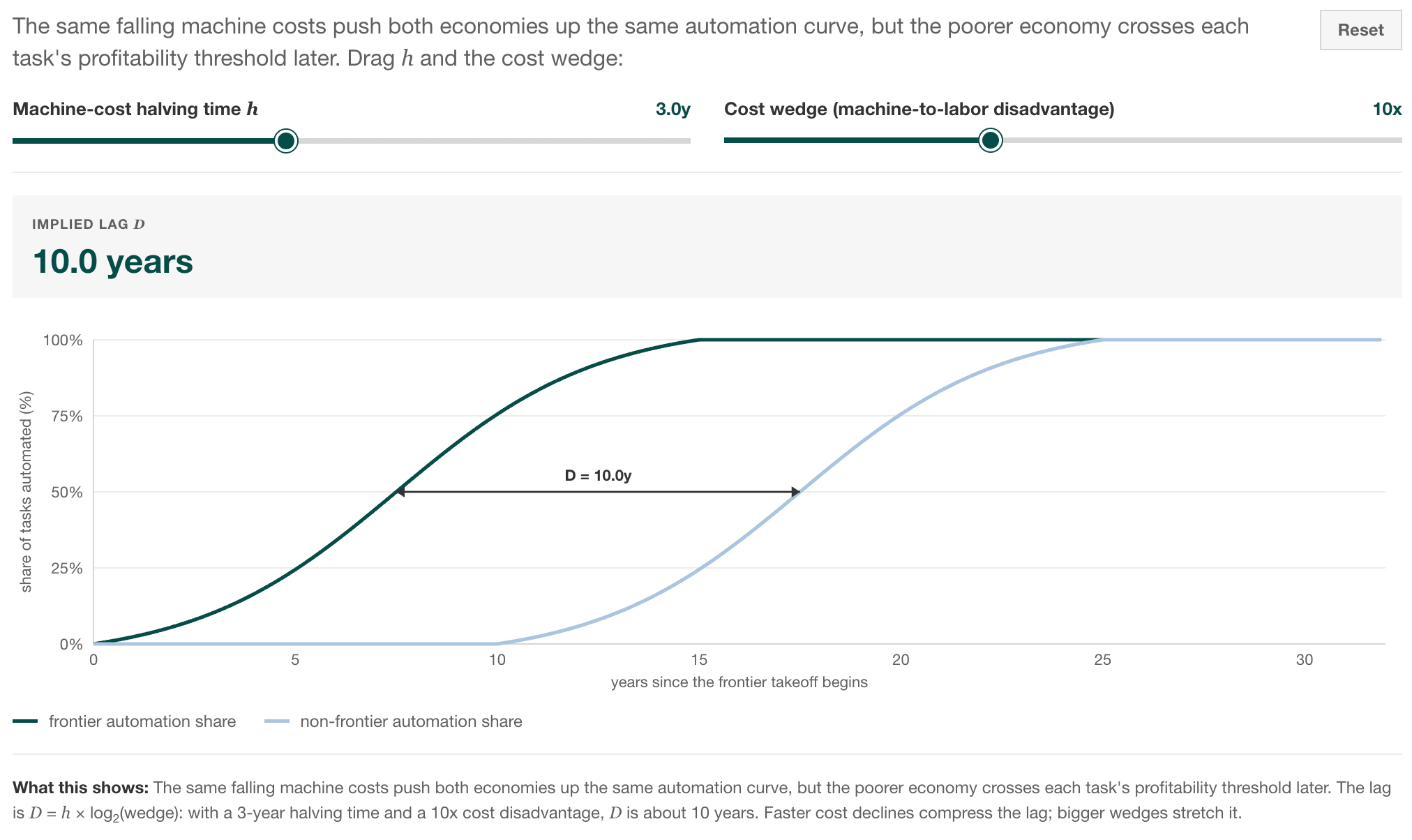
The best way to calibrate D that I found is to use the historical evidence in Comin and Mestieri. The authors measured adoption lags for 25 technologies across 139 countries, over about two centuries. They find poor countries got the internet roughly 6 years after rich ones, and PCs and cellphones roughly 6 to 8 years after. So the time it takes for a new technology to “arrive” in a poor country is shrinking.
However, they find that the gap in how intensively countries use technologies once they arrive has been widening. The smartphone, for example, took about 15 years to reach half of Sub-Saharan Africa. Smartphones are a relatively cheap consumer good, while “AI in productive activities” entails expensive machinery that requires complementary capital. So my central guess is D = 10 years, which seems like a conservative guess to me, since in the model D is better mapped to the intensity (fraction of tasks automated) rather than the availability of AI for productive activities.
Step 2. Now add the lag. Each economy keeps its own baseline growth (adjustable below) and the follower receives the boost D years late; the orange wedge between the curves is the divergence engine:
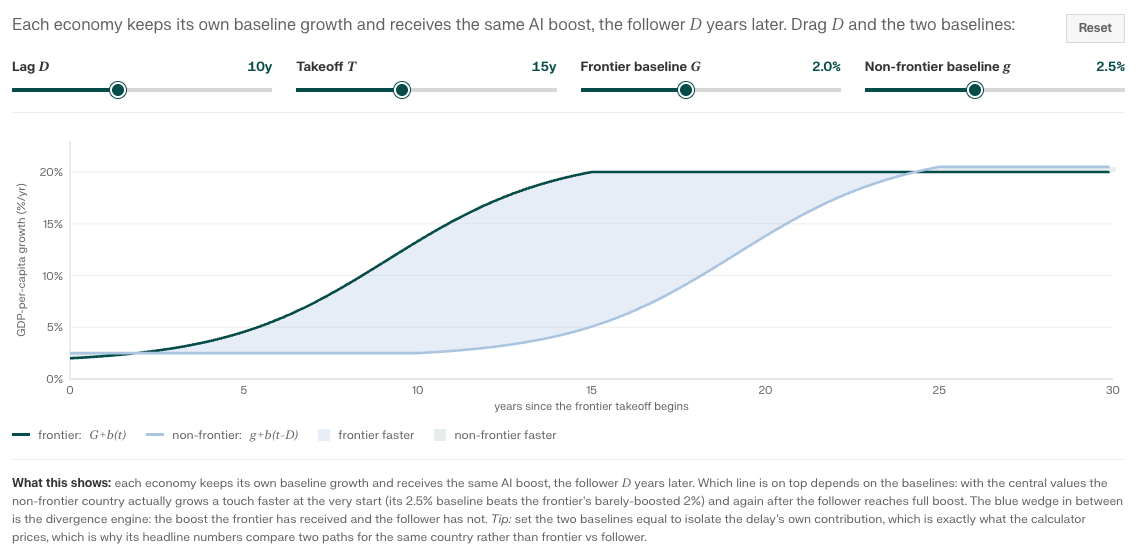
Tip: Set the two baselines equal to isolate the delay’s own contribution to the gap. That isolated part is exactly what the calculator prices, which is why its headline numbers compare two paths for the same country rather than frontier vs follower.
To the numbers
Step 3. Price the wedge: the headline numbers and the two income paths, live. Drag D and T:
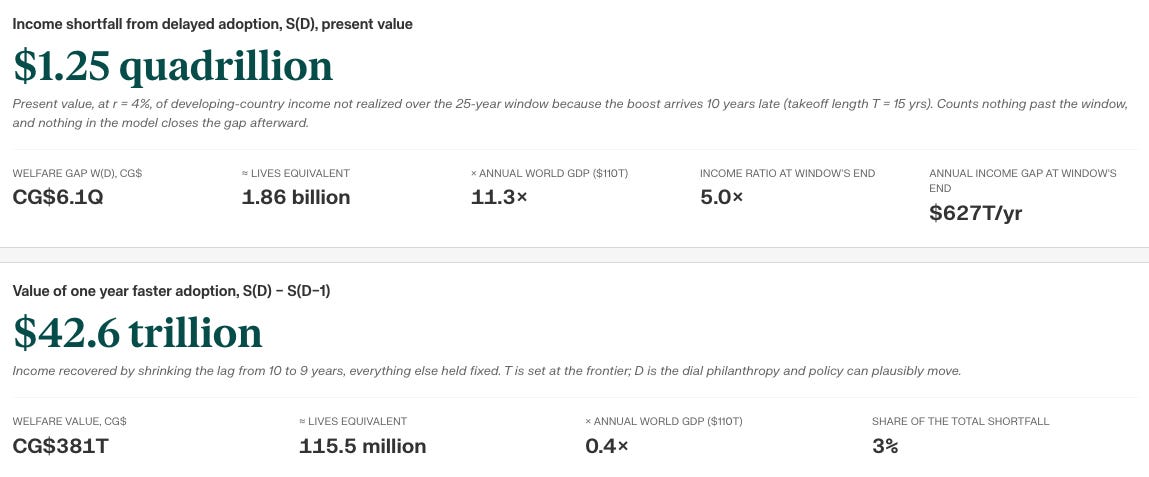
The calculator below compares two paths for the same developing-country bloc: one where the AI boost arrives immediately and one where it arrives D years later. Both start at today’s average non-frontier income ($4,200 per capita), and I apply to both a 4% discount rate to compute the NPV of the accumulated GDP difference between them.
Here is what the central scenario (takeoff length T = 15, lag D = 10, gfull = 18%, a 25-year window) implies for the 5.4 billion people who live in low- and middle-income countries outside China:
By the end of the window, average income in the developing world is about 5x lower than it would have been with immediate adoption.
The present value of the income shortfall is about $1.2 quadrillion. For scale, the entire world currently produces about $110 trillion per year.
In welfare terms, the gap is worth about 6.1 quadrillion Coefficient Giving dollars, using the CG methodology to value income gains (a 1% income increase for one person for one year is worth CG$500). In welfare units, the total gap is equivalent to saving roughly 1.86 billion lives.
Each year of faster adoption is worth about CG$381 trillion, roughly 115 million lives in welfare units. In my view, this is the most important number because I believe economic policy can change D and philanthropy can help.
My main takeaway is anything that accelerates developing countries’ catch-up has welfare returns at a scale that’s hard to find elsewhere in philanthropy. Conditional on TAI having an important effect on frontier growth, it’s hard to imagine ways in which the rate of catch-up in the aftermath doesn’t matter enormously. In fact, ensuring that developing countries’ growth rates stay close to the frontier growth rate might be the second most important task in terms of human welfare, after preventing AI-induced catastrophic risks.16
Why care about catch-up growth if TAI will create great abundance and raise everyone’s welfare?
Rapidly growing frontier economies would produce a lot of goods. The price of tradable goods could fall significantly in international markets, and new amazing products could become available. If developing countries can import super cheap electric cars and pills that cure all diseases, why care about economic growth?
That’s because growth still matters for two reasons.
First, more money increases access to those new goods. Even if great AI-produced goods become available, poor countries will have little money to pay for them if their income is low. Increasing their GDP is the best way to improve their access to these great new goods.
Second, this is a counterfactual comparison about relative incomes. The welfare gaps here compare GDP in non-frontier economies with what it could be if the adoption lag decreased. The model suggests that AI-induced takeoff in frontier economies eventually benefits everyone — by an enormous amount — but by not trying to accelerate catch-up, we’d be leaving a huge amount of welfare on the table.
What happens after the detachment window?
So far I have only talked about what happens in the detachment window – but what happens after can undermine the main point I’m trying to make here. My main point is that accelerating catch-up growth during the detachment window matters a lot. An objection that AI-believers could have is that the initial detachment phase doesn’t matter much because it’s short and what follows is quick catch-up, or a post-scarcity future where money becomes a useless concept and income differences stop mattering. If so, the welfare gap we’ve just estimated is just a blip, a rough couple of years on the way to somewhere great for everybody.
Why spend attention, let alone money, on a blip?
To answer that, let’s be concrete about what could come after the detachment period modeled so far. I can imagine four main scenarios:
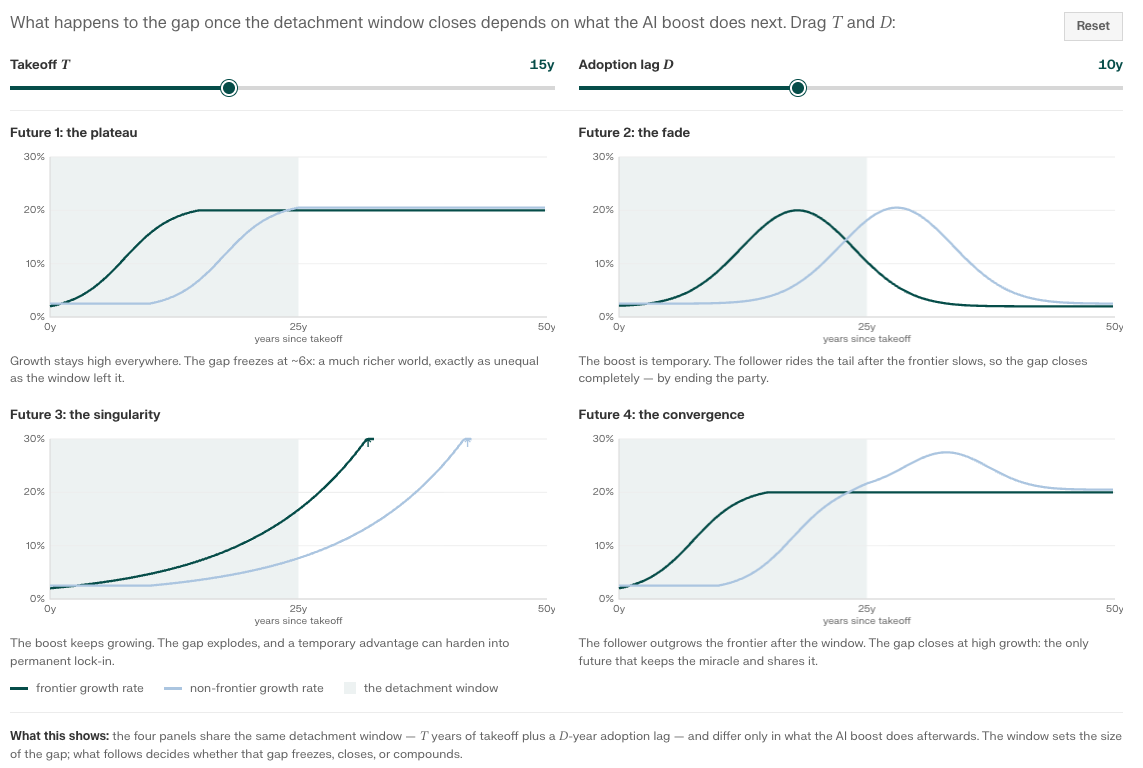
Future 1: the plateau. Growth rates stay high everywhere. The income gap freezes at roughly 5x and stays there. We have a new, spectacularly richer world, exactly as unequal as the window left it.
Future 2: the fade. The AI boost turns out to be temporary, and frontier growth comes back down. Then something nice happens: The follower rides the tail of the boost after the frontier has slowed, growing faster than the frontier for a while, and a temporary boost plus a pure lag creates only a temporary gap.
Future 3: the singularity. The boost keeps growing and the gap explodes.
Future 4: the convergence. Developing countries grow faster than the frontier after the window, the way classic growth theory says capital-scarce economies should. The gap closes while growth stays high.
The “it’s just a blip” objection only works in future 4. In future 1, the window’s gap is permanent. In future 2 it closes, but closing it one year early still creates the same amount of welfare we estimated here. At the central calibration, the detachment window is 15 years. That’s billions of person-years lived at incomes several times below what faster catch-up would have delivered.
Future 3 could go either way. A singularity could be the future where the early gap developed in the detachment window matters most, because whoever ends the window ahead may get to write the rules of everything after. In 2021, then co-CEO of Open Philanthropy Holden Karnofsky wrote that a state in which “key things about society, such as who is in power or which religions/ideologies are dominant, are locked into place indefinitely, plausibly for billions of years,” is possible and even likely. The argument is that, if some groups become much more powerful than others when TAI arrives, they might use a temporary advantage to consolidate a permanent position of advantage, or even dominance, over the groups lagging behind. On the other hand, the singularity could create a post-scarcity world where initial income differences become irrelevant. It’s too hard to think about what happens in this scenario, so I skip it.
Future 4 is the world to aim for. It’s the one that maximizes human welfare, and if you were confident we get it by default, the right policy really would be to accelerate AI and not worry about catch-up growth at all, since faster arrival means faster convergence. But look at what future 4 requires: Post-window growth has to be driven by non-rival ideas, things poor countries can copy for free, rather than by capital accumulation, which has owners, price tags, and shipping delays. The entire argument of this post has been that AI’s gains during the transition are embodied in expensive machines. Betting the welfare of five billion people on that not being true seems hard to justify. So let’s aim for fast convergence, but not assume it.
What to do about it
So the trillion-dollar question: Is there anything poor countries, and the people who care about them, can do to catch up faster in the aftermath of TAI?
I think so. Economic policy decisions will meaningfully speed up or hinder catch-up by poor countries after TAI. I won’t pretend I know exactly what policies. But I have some ideas that I will write in a follow up post.
I expect to learn a lot in the next couple of years. My day job is making grants to accelerate catch-up growth, and I’m keen to understand how our grantmaking should change if a frontier AI takeoff materializes (or in anticipation of that) so we can better help countries. I will be talking with policy makers and observing the data, and I will keep you updated.
In the meantime, if you have reactions or ideas, especially concrete ones about what countries should do, please reach out.
Coda: the main ways this could be wrong
I divide the objections here into two camps, the ones that have an AI-skeptic flavor and the ones that have an AI-believer flavor. The main point of the post is that catch-up growth becomes super important in the aftermath of TAI. Broadly, AI-skeptics object because they think AI won’t cause much growth, and AI-believers object because they think AI will automatically benefit everyone. I go into the main reasons I’ve encountered for skepticism on both sides.
AI-skeptic: The AI-induced takeoff never comes. Most mainstream economists put AI’s growth effects at tenths of a percentage point, and if they’re right, this post is just a thought experiment.
Response: On the question of how powerful AI will be, the AI believers’ track record over the past five years has been better than the skeptics’. I think mainstream economists are a bit too skeptical, and I think this is a good joke.
AI-skeptic: The AI-induced takeoff you assume is too high. In the Forecasting Research Institute’s rapid-progress scenario, AI experts forecast roughly 5% annual growth in 2050, while economists and superforecasters forecast less. The IMF’s high-adoption scenario for sub-Saharan Africa estimates a cumulative GDP gain of about 4% over 10 years. Why does your central scenario reach 18%?
Response: Eighteen percent is the growth rate under full automation. The forecasters and the IMF paper are not assuming full automation; they allow for automation to get bottlenecked by regulation and a myriad of frictions. To get closer to those scenarios, you can slide the fmax parameter and reduce the share of automated tasks at the end of the detachment window. I assume full automation as default because I see the exercise here as conditional on accepting the AI-believer point-of-view. In that case, 18% as the final growth rate might be too low. In a recent paper, some of the most prominent economists in the field show that, once machines can produce the next generation of machines and automated R&D, exploding growth rates (unbounded) are possible. So I do not regard 18% as the maximally aggressive scenario.
AI-skeptic: The AI-induced takeoff comes, but it stops at relatively low levels of total automation f because AI only automates cognitive tasks.
Response: I admit that it is a (so far) implicit assumption in my modeling scenario that the AI-induced growth acceleration includes automation of most physical economic activities, so the maximum f is not too low. That is, I want you to take as part of the modeling scenario that robots are advanced enough that they can automate most physical economic activities, from cooking to construction.17 You don’t have to believe that nobody will pay for fancy human-chef meals anymore, just that robots can do physical things almost as well as humans in almost all economically relevant areas.
If we don’t assume that, then the AI takeoff peters out at a relatively low f, the scenario becomes less interesting and the implications for non-frontier economics change a lot (because they can specialize in tradable physical activities, given that they have a lot of relatively young humans). If you are skeptical how much AI and robots can automate in the next 15 years, the only thing I can do now is to promise a future post about robots, and concede that without automation of physical tasks the main point here becomes much less important.
AI-skeptic-believer: D=10 is too low relative to historical evidence, and maybe TAI itself causes the lag to grow. Rasmus Andersen, author of the quite interesting AGI Growth Atlas, commented on a draft of this post:
“The model says followers are on the same S-curve shifted by D years. But the dominant historical outcome in many ways was non-catch-up: your own opening (Mali, 5x to 25x) is not the exception, and you can argue full adoption of second and third industrial revolutions still hasn’t happened (electricity and effective ICT use remain incomplete across much of the world two generations on). Historically the four reasons you listed didn’t produce a fixed lag; they produced follower curves that many times didn’t complete.
The few who did reach the frontier used low wages as the entry ramp into tradables, reinvested earnings as physical capital and eventually made it there. Foreign capital generally came later, I would argue. Given TAI may foreclose that path to capital accumulation outside the frontier by automating the low-wage tasks themselves, doesn’t that mean catch-up and convergence in adoption are even less likely this time around?”
Response: In the model, the follower is assumed to trace the same growth path as the frontier, only shifted. This implies that, after D years, even Mali will reach the same level of automation as the US and get the same boost to growth.
This is probably too optimistic. Persistent differences in infrastructure, energy, conflict, or institutions could instead leave poorer economies with a lower automation endpoint or a lower growth rate even after AI-induced automation has run its course.
A way to incorporate this in the model would be to set a lower growth rate after maximum automation (gfull) or lower maximum rate of automation (fmax) to poor countries. These changes would make the main point of the post stronger, and I wanted to keep things simple and not create more free parameters.
AI-believer: TAI causes the lag D to decrease. Maybe AI will diffuse to poor countries faster than other technologies, and maybe AI itself will help increase the speed of technological diffusion. The main reason I can imagine for this is lowering technical barriers for complex economic production. If a firm has trouble operating a chemical plant in Nigeria now for lack of chemical engineers, Claude 5.1 might dissolve this barrier.
Response: I’m actually hoping that non-frontier economies do everything they can to lower the adoption lag, and hoping to work in and help fund initiatives aiming at that. I think AI itself lowering technical barriers for running complex economic activity is a reason for hope. But I don’t think it’s strong enough to overcome the four barriers I listed above.
AI-believer: Trade boosts catch-up. A big missing ingredient in the model is trade. AI adoption in frontier economies can increase the demand for non-frontier exports a lot, which would accelerate their growth.
Response: I think this is real but not enough to meaningfully decrease the gap. In a scenario where the AI-induced frontier take-off includes the automation of physical production, manufacturing becomes more competitive in frontier economies than in non-frontier ones. In fact, China (which for our AI-adoption purposes I classify as frontier) is already rapidly automating manufacturing, and I don’t see why Ethiopia’s garment industry would become more viable after TAI than it is now.
I think the exports that will see more demand are extractives (especially the ones used to build the machines doing the automation, or the energy to power them) and tourism. Non-frontier economies should try to maximize this opportunity, but the opportunities are likely to be narrow and to require clever economic strategy – we shouldn’t just assume that trade automatically causes catch-up.
AI-believer: Regulatory barriers in frontier economies reduce the gap in adoption. We can imagine that relatively strong governments, unions and pressure groups could lead to high and well-enforced regulation against AI in frontier economies. If non-frontier economies have weaker regulatory and regulation enforcement capacity, these barriers could be lower in them, which would compress the adoption lag D.
Response: This is a plausible argument, but it doesn’t seem strong enough to overcome the four barriers I listed above. Frontier economies would really have to regulate away AI use in the economy to overcome the barriers, and competition between US, China, and Europe has been pushing them to race and suppress regulation. I expect this race dynamic to continue well into the detachment period. Even if rich democracies regulate AI a lot, the Gulf countries, or richer middle-income countries like Russia, would be in a better position to automate their economies than the truly poor countries.
Learn more
Comin and Mestieri (2018), the main source for the adoption-lag calibration
I’d like to thank Oliver Kim, Justin Sandefur, Joseph Levine, and Rasmus Andersen for very thoughtful comments.
This is a paraphrase of one of the most famous passages in development economics. Robert Lucas, economics Nobel laureate, observing the large income differences between rich and poor countries in 1988, wrote: “Is there some action a government of India could take that would lead the Indian economy to grow like Indonesia’s or Egypt’s? If so, what, exactly? If not, what is it about the “nature of India” that makes it so? The consequences for human welfare involved in questions like these are simply staggering: Once one starts to think about them, it is hard to think about anything else.”
GDP per capita around 1800 from the Maddison Project Database; Mali has no direct pre-1950 estimate, so the 1800 figure uses West African estimates as a proxy — call it roughly 4-6x, and I use 5x. Today’s ~25x is in PPP terms from the World Bank WDI; at market exchange rates the gap is roughly 45-50x. The two-century divergence pattern is standard economic history: Pritchett (1997), “Divergence, Big Time.”
For calibration on the debate: AI insiders predict sustained 10-20%+ annual growth after full automation (Amodei is the clearest articulator); most mainstream economists put AI-induced excess growth at 0.1-1.5%/yr (Acemoglu 2025). Everything below conditions on the insiders being roughly right. In a companion paper, Davidson, Halperin, Houlden and Korinek calibrate how far the threshold is — uncomfortably close: “fully automating software research and modest (5%) automation in other sectors generates a singularity within six years.” Korinek, with Philip Trammell, also recently released a review of the theory whose central result is stated with unusual bluntness for a working paper: “Robustly, fully automating production alone (so that machines can self-replicate) would dramatically raise the growth rate” — with a reminder to the skeptics: “The global economic growth rate unambiguously accelerated with the onset of the Industrial Revolution; we have no reason to insist that it cannot accelerate again.” For more of the case: Amodei’s Machines of Loving Grace, Erdil and Besiroglu’s review of the explosive-growth arguments, Karnofsky’s Most Important Century series, and Jack Clark’s Import AI for the week-by-week evidence.
If the baseline frontier growth rate is G, then growth after TAI is G+b(t), where b(t) > 0 is the boost at time t after TAI arrival. The AI-induced frontier economic takeoff starts with a period, which I will refer to as the ‘detachment window’, when b(t) is increasing over time.
The boost in non-frontier countries is b(t–D).
The founding paper is Zeira (1998); Acemoglu and Autor (2011) and Aghion, Jones, and Jones (2019) are the modern workhorses. In Aghion, Jones, and Jones the growth effects of AI come precisely from the automated fraction of tasks rising over time, just like here. Their emphasis differs from mine: they mostly study automation proceeding at a steady pace and its balanced-growth implications (their headline result is Baumol’s cost disease: growth ends up governed by the tasks machines cannot yet do), while I push f toward its ceiling to study a takeoff. The production function is the same one.
Technically, rising f alone is not enough: we also need capital accumulation running underneath (investment building the machine stock). What rising f does is let that accumulated capital escape the diminishing returns imposed by human bottlenecks. See the technical note for the derivation.
Note that T is not “years until AGI from today”; it is the length of the transition to a fully-automated economy once it starts.
Guessing the midpoint is an imperfect way to pin down this number, since the available predictions are not exactly about the object I am modeling, but mapping it to external predictions at least keeps me honest. The fast end comes from the AI-research evidence: METR’s measurements have the length of software tasks that frontier agents can complete doubling roughly every four to seven months, and Jack Clark now puts more than 60% on no-human-involved AI R&D by end-2028. If the whole economy moved at software speed, T would be something like 5. The slow end comes from diffusion history: economy-wide transformations have taken decades even after the technology worked (electric motors needed forty years to conquer American factories), so a deployment skeptic can read T = 30. My central T = 15 splits the difference: a few years for the digital and research phase, where the fast evidence applies, plus roughly another decade for the parts of the economy that have never moved at software speed — power, factories, logistics, regulation, and firms reorganizing around the new tools.
This is also why “AI over the phone” helps but doesn’t close the gap: the tasks that dominate poor-country output are exactly the physical ones.
Lucas (1990) on why capital doesn’t flow to poor countries; Alonso, Berg, Kothari, Papageorgiou and Rehman (2020) model the AI-specific version and find the divergence can worsen; Korinek and Stiglitz (2021) reach a similar conclusion through AI’s effects on developing countries’ terms of trade and comparative advantage.
The wage-automation gradient is documented in Alonso et al. (2020): robot intensity rises steeply with wages across countries (elasticity of roughly 1.5-3 in IFR robot data).
Clark (1987), “Why Isn’t the Whole World Developed? Lessons from the Cotton Mills.”
In the real world, different countries will have different lags. Vietnam has a big manufacturing basis, and Brazil has a lot of critical minerals. Both can help accelerate catch-up, for example. The idea here is to have a parsimonious model capturing the main differences between frontier and non-frontier countries.
If you assume TAI is real, you care primarily about humans, and you succeeded in preventing an AI-related catastrophe. All huge ifs for AGI-pilled people, I admit. Call it the third most important problem if you will. A secondary reason for the lag that didn’t make the main list: the political economy of automation is harder in poorer countries because they are younger. Africa has the largest number of young people reaching working age of any continent, and people who want jobs will resist automation more than aging societies like Japan, where robots fill vacancies instead of replacing anyone.
We can borrow a term from a former co-worker and call this the industrial explosion, even though my views are more extreme than the ones in the linked text (i.e., I think automation might be slower and taper out earlier than the authors).
Very interesting article. Thinking of geopolitical factors could add more components to the scenarios.
There would be quite substantial geopolitical pushbacks against scenario 4. Size of pushback would likely be correlated with population of the catching up countries. Morr intensely directed against the future largest populations like India, Pakistan, Nigeria, Ethiopia - as they are moving up the ranks from regional players to regional powers to global power challengers.
Historical examples of similar pushbacks are plaza accords/1987 tariffs against Japan, semiconductor sanctions/EV-solar panel tariffs against China.
FWIW I've long argued that the best way to accelerate catch-up growth would be to subsidize long-term migration from China to the world's poorest countries--I hint at that in Culture Transplant. Human capital externalities rule everything around me, after all.
It's possible that TAI will accelerate catch-up, since imitation is easier than innovation. But if (formal and informal) institutional quality is the big barrier to catch-up, then it'll be tougher for TAI to dramatically close gaps unless people hand over a lot of institutions to TAI. I'd be happy to see that-- AIs as 1/3 of the upper house of the legislature in poor countries, for example-- but it'd be a tough sell.
Perhaps that'd be another grant program that could accelerate catch-up: subsidizing experiments that offer major roles for AIs in formal governance in poor countries. Start with traffic courts, work up from there!